Dewatering Dramas – 22 May – 14 Jun
Period Covered 22 May – 14 Jun 12
Summary: Dewaterng
A really busy few weeks, ensuring that the Dewatering Package was given State Approval, the contract was signed between JHG and the Subcontractor (Mobile Dewatering) and making sure all of the necessary prep work and safety paperwork was in place for their arrival.
To be brutally honest I have learnt an awful lot and though John Holland are happy with everything I would do things differently if I had my time again….I have learnt valuable lessons about risk V programme but am pleased to report as I write this with things are getting back on track, abeilt with a significant delay.
Key lesson learnt – Water has the potential to be very dangerous…..
During this period I have completed the following on top of routine work:
- Consultations with client to convince them original dewatering plan is most sensible and to discount sewer option.
- Written Groundwater Management Plan
- Dewatering Activity Method Statement written. The mountain of other H&S paperwork (Plan Hazard Assessments, Task Risk Assessments, Induction paperwork)
- Chaired subcontractor kickoff meeting
- Dewatering Co-ordination and installation (including installation of 1 x Monitoring Pizo)
- Re-infiltration licence approval from Department of Water
- Emergency storm repairs
- Dewatering QS work
- State approval reports written for bus stop relocation and Sunday working
Work on site.
Dewatering Set Up slide show…. from start to finish (Sorry its in 3 ppts)
So its all about me at the moment. Works has slowed to a crawl as the site waits for the dewatering to begin. The delay is a result of a combination of factors but the finger can be pointed to some slow work by the John Holland contract administrators and the client perusing an option that they had discounted 2 months earlier. All this meant the subcontractor did not start on site until 5 days after dewatering was due to start. With 10 days of set up and installation required this is a significant delay.
I will cover the whole saga and the different options to dispose of the water in my next AER, but in short the water table needs to be lowered by 0.5 -1m around 180 pile caps and up to 2.5m around the cores (10 in total). The water will be treated on site and reinfiltrated back in to the ground through 30 recharge spears.
Temporary work: Part 1
Due to the delay in mobilising to site, a temporary solution for disposing of the extracted water was proposed whilst the permanent system was being installed. A temporary reservoir/sump was dug. Unfortunately this was way too small and breached over the first night. Unfortunately the water did not flow in the direction of the open “floodplain” we had cleared but cut a deep channel at 90 degrees to the proposed overflow area. This resulted in 2 legs of an access scaffolding being undermined and another subcontractors compressor being tipped over. As a result Saturday morning was spent doing a lot of emergency works to rectify this issue. Thankfully no one hurt, but a reminder of the danger of trying to contain a large body of water.
Temporary Works Part 2.
Having learnt this lesson you would think we couldn’t possibly try this again, but the pressure on the work package manager to remain on programme is such that a second larger reservoir was constructed in another corner of site. Understanding the permeability of the soil better and the flow rate I calculated that this second reservoir was very likely to overflow after 16hours and it was not worth the risk involved (dewatering needed to last at least 4 days to bridge the gap to the permanent system). Overruled, the pumping began….as you can see in the photos this very nearly ended in disaster again, with the pump being turned of with just 10cm to spare at 630am the following day.
As a result of these 2 instances the decision was made to wait for the main reinfilatration system to be set up.
This began on 20 June and so far has worked very well. Currently a 110m2 area is being dewatered with the number of excavation steadily increasing over the next 2 weeks – due to the limitation of the treatment units the amount of water which can be dewatered at one time is 30l/s so careful manageme
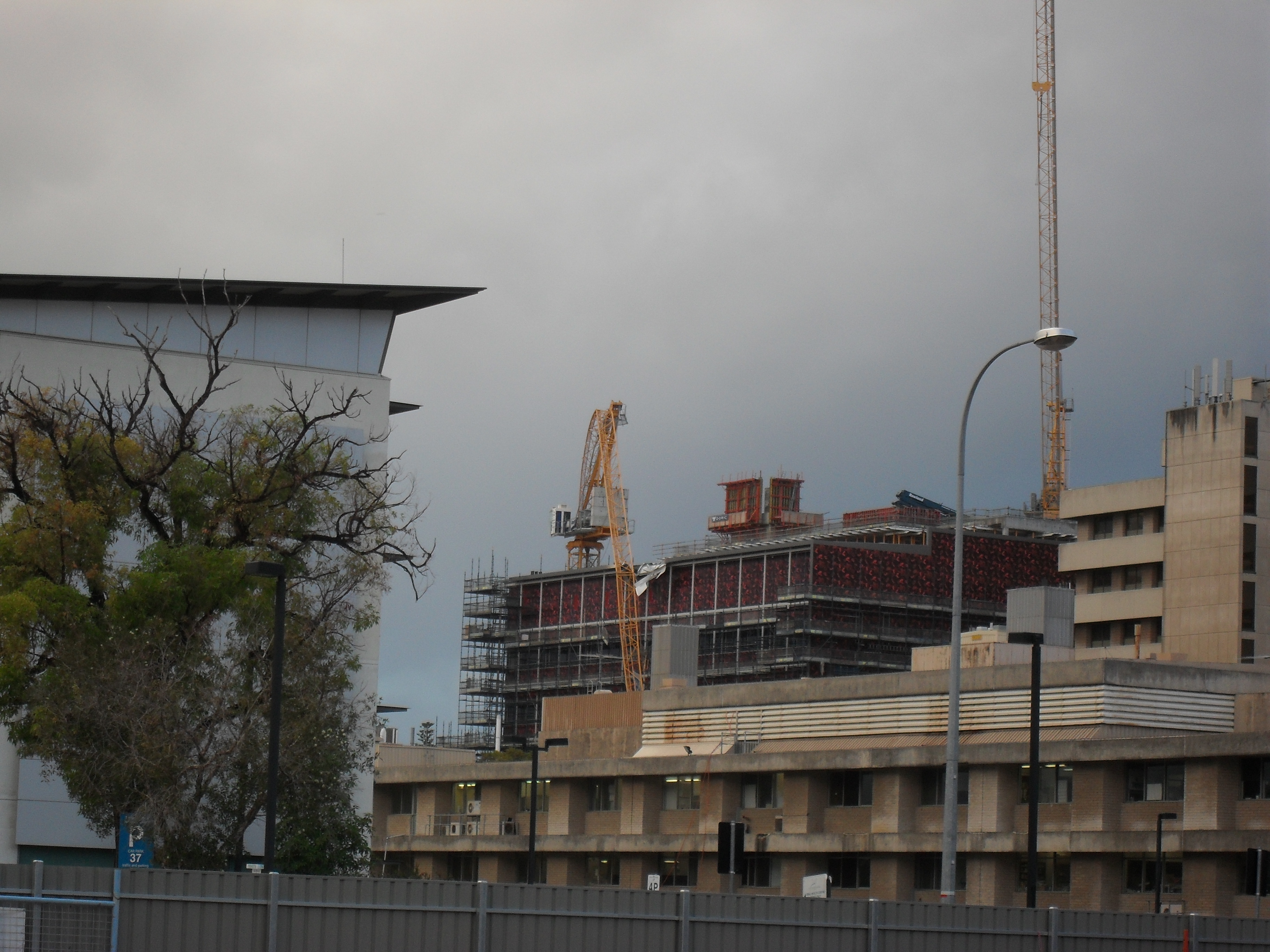
View from my Site Shed looking at collapsed tower crane on enighbouring build
nt and programmeing is required
In other news…has Chris W been let loose on the cranes in Perth (view from my site office looking out on the new cancer centre building). Strong winds in Perth, Western Australia, took the luffing jib of a tower crane over the back and onto the roof of a hospital on Sunday as winds as high as 140kph caused widespread damage to the region. While not yet fully confirmed we believe that the site was closed when the incident occurred and the crane was parked up with the jib at around 75 degrees and the slew brake left on, rather than the crane being allowed to ‘weathervane’.
Further Work
- Dewatering Programme Planning
- Environmental Monitoring
- Work on use of Stormwater System
- Post Tensioning Tender Review (awaiting for State to lift moratorium on all tenders…….long story!!)
- AER 3 – Dewatering, Health and Safety Paperwork and Boundary issues on Site, Relationship between Client, Existing hospital and JHG.
- TMR 2 Research – Project Bespoke Contract v NEC3/ICE 7th
 Holdfast Training Services Trial Blog
As you might expect….Ahmmm lovin it!
Mind you I’m looking forward to the accompanying TMR/ thesis work ….because I’m also confused.
The four ?’s for me:
1 The dewatering spears – the tops look small ;is this downhole suction pumping or ejector ( the heads look like ejector but that would be unusual in SAND)?
2 The recharge points appear to be very close to the dewatering…..and right against the piles ….is there something very clever going on regading limiting the drawdown around piles or…well…what?
3 I know this is after the horse has bolted …..but ***k-me who thought is was a good idea to build a kiddies sandpit and fill what with the pump water?
4 The water treatment system allows the gw to go to the public sewer ( instead of the kiddie play pit)? I note that there’s a chlorinator involved ? Is thr gw of poor quality… all I’ve ever down is pass it through settlement
Loving the crane collapse…..if it’s windy just let it swing ( mind you remember to lift the hoist tackle!)
Steve
Obviously lots of fun on site. I agree with John…when I was young I had great problems getting sand on the beach to hold back water for any length of time.
I also look forward to your AER and TMR.
On the site I worked on in Louisiana the main structure was serviced by massive tracked cranes. One night they were pouring concrete the other side of the structure using concrete skips. No one checked and they boomed the crane too far out whilst it had a full skip load of concrete. Yes…overturning moment exceeded restoring moment and in the morning we were greeted by a massive jib lying across the structure with the concrete not being in the correct location……and that was on the day of a VIP visit! Fun all round.
Keep up the good work.
Best wishes
Neil
John, Neil,
Good to hear from you. Sorry for the delayed response, it’s been another busy few days…..
John thanks for your questons..I’ll answer them as best I can:
1 The dewatering spears – the tops look small ;is this downhole suction pumping or ejector ( the heads look like ejector but that would be unusual in SAND)?
I must admit for a while I had assumed that the dewatering system was an ejector – site supervisor scratched his head a few times so after some further investigation I have been informed that it is suction pumping. The compnay have gone back to basics having had real problems with high tech pumps which are too fragile for the job. More details of the positive displacement pump at: http://www.bbapumps.com/index.php/producten/serie/id_competentie/2/id_serie/8/well-point-piston-pump-pt-series.html
2 The recharge points appear to be very close to the dewatering…..and right against the piles ….is there something very clever going on regading limiting the drawdown around piles or…well…what?
You are right the recharge spears are close to where we are dewatering from, however there are 2 sets of reharge spears which are seperated by about 100m, they are also positioned so water will drain away from site (towards the swan river) and we are controlling which recharge spears we use to maximise distance from dewatering point. Currently the recharge wells are working very well as the water is drainly quickly away in the sand. Mobile dewateirng normally work on a gravity fed recharge rate of 1l/s per recharge well, we have emperically found with our site recharge well that the ground conditions could cope with at least 10l/s each.
Currently we are only dewatering 0.5 -1 m below natural groundwater level. The trigger level has been set at an drop or rise of 1m around the ouside of the retaining structure. The chimney and the capping beam movement are also being monitored to detect any problems.
3 I know this is after the horse has bolted …..but ***k-me who thought is was a good idea to build a kiddies sandpit and fill what with the pump water?
I agree – but the pressure to try soemthing to stay on programme was such that something was needed, even if it was just to look like we were doing something!!… Disapointed that it took two attempts for someone to realise I wasn’t making my calcs up!!
4 The water treatment system allows the gw to go to the public sewer ( instead of the kiddie play pit)? I note that there’s a chlorinator involved ? Is thr gw of poor quality… all I’ve ever down is pass it through settlement.
My understanding is that the real purpose of the tratement unit is to remove the iron from the removed water – if this is not removed there is the possibility that the recharge wells will “silt” up – no idea if this is true but this is what I am being told by the Subcontractor.
The groundwater has a few worrying levels in it (I am waiting for a finalised moniroting report, only seen draft results so far). The rules for disposing of groundwater is to not make the intial readings worse…There is also a worry in Western Australia about disturbing pockets of Acid Suphate Soil, as a result there is a desire to keep the PH within acceptable limits which is controlled by the treatment unit.
We also have a contingency plan (mainly formed before the success of the recharge wells was known) to dispose of excess water through the stormwater system. This flows directly into 2 lakes and thus ensuring water quality is a more stringent requirement.