CLOUD BREAKING DESIGN – AUSTRALIA 108
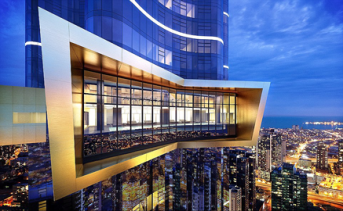
‘Australia 108 is a highly sculptural residential tower unlike any other in Australia. Its slender form is highlighted at the Cloud Residences levels by a golden star burst expression and then morphs into a curvaceous profile against the sky. The star burst which contains the resident facilities is inspired by the Commonwealth Star on the Australian flag and is an obvious celebration of the sense of community within the building’ – Fender Katsalidis Architects
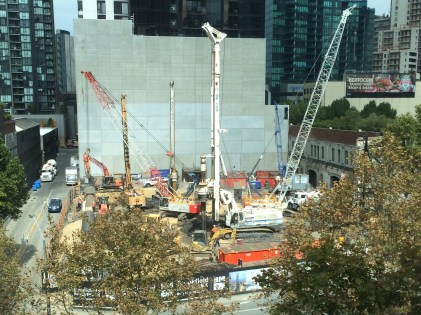
This is what it looks like now….
This is what it will look like in 2020…
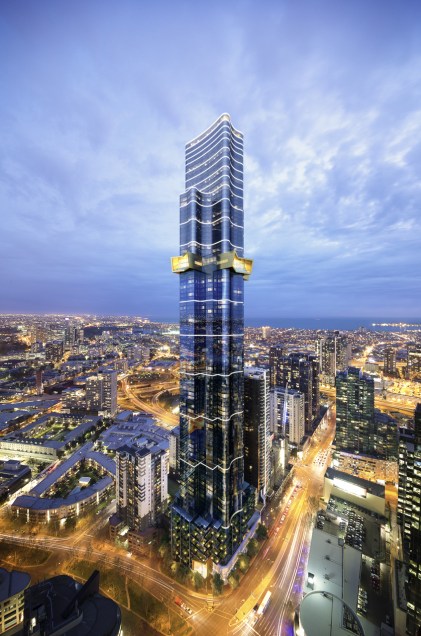
Project Overview: Australia 108 will be a 319m, 100 story residential building in Melbourne. When complete, it will be the tallest residential building by roof line in the Southern Hemisphere.
It is a design and build, fixed-sum contract to the value of $500m AUS. There is one basement level, one level of retail, 10 podium levels for car parking and the remaining floors to level 100 will be residential and amenities. To note the penthouse has sold for $25m AUS (equivalent to £12.5m) to give an indication of the quality and desirability of this build. Site preliminaries commenced in late May 15 and the foundations in Oct 15. The basement structure is due to finish in Sep 16 when construction of the superstructure should commence. If all goes to plan, the project should be reaching the soaring heights of level 10 by Christmas.
The 60 x 45m site is located on Southbank Boulevard approximately 300m from the Yarra River. It is situated on poor quality river deposits of soft silt and river gravels down to circa 35m where a medium – slightly weathered siltstone with good engineering properties is located. All high rise buildings in this area, bar one, have been constructed with podium levels above ground to house the car parks and to minimise the depth of excavation; this building is no different. There will be an excavation to a depth of one basement floor under the building footprint with a lift overrun under the core to a depth of two basement floors. Due to the available space on site, the majority of the excavation is being conducted by battering back the ground. Secant piling is being used for the core excavation and to protect a heritage façade from settlement. The groundwater was identified at a depth of 3.25m (RL -1.15m) during the site investigation but it is anticipated it could reach RL 0.0m from historical records.
The foundations are being constructed from replacement piles. The bored piles range in size from 2100mm to 1200mm dia. A polymer fluid has been used to support the bore holes until concrete pour. The remainder are CFA piles of either 900mm or 600mm dia. The only major issue encountered has been reduced boring rates due a narrow band of basalt in one corner of the site; this was factored into the programme and the subcontractors are on track to finish on time. Due to the poor engineering quality of the upper ground horizons, the piles rely heavily on base resistance and are designed with a socket length into the rock. This socket length is calculated to ensure that settlement of the pile is within tolerance under SLS loads, and is sufficient to resist any tensile force acting on the pile. Quality assurance is high to ensure that the design resistance is fully mobilised.
My Roles
1. Jet Grouting. I have arrived close to completion of the piling and the excavation commences next week. A geotechnical specialist, Menard Bachy, arrived on site today to do ground improvement works prior to the excavation. They are providing two functions: the first to place the soft piles in the secant walls by jet grouting columns between the hard piles; the second to jet grout a 1m thick water-reduction plug at the base of the core excavation. While this will not completely water proof the excavation it will significantly reduce the inflow of water to negligible levels. The ground slab will be poured on top of the grout plug. I have been tasked to work with the sub-contractors and provide the co-ordination, progress tracking and QA for this part of the project. It appears to be quite an interesting method having done some back ground reading on the subject, so I will maybe do a separate blog on the topic once I’ve spent a bit more time with the sub-contractors.
2. Starburst Co-ordinator. The starburst is the yellow clad star at levels 69-71. This will house plant at level 69 and residence amenities, including infinity pool, at levels 70 & 71. It will cantilever approximately 8m from the superstructure. At present this is a preliminary cost and has yet to be designed. A little headway has been made on the permanent structure by the Structural Engineers and a method statement has been drafted by a senior site manager. The two do not correlate and the initial work was only produced in order to submit a bid for the project. It is expected that the current proposal will radically change. I have been assigned the task of Starburst Co-ordinator, much to the relief of the other graduates. My role is to co-ordinate the ‘meeting of minds’ including those belonging to the structural engineers, steel consultants, concrete sub-contractor and the ‘brain’ from Multiplex’s Engineering Innovation Group (EIG) who is a world leader in high load structural connection design (James Murray-Parkes – google him). The aim is work out how this starburst is actually going to be built, produce the method statements, track progress and keep momentum on this part of the project and ultimately work with the commercial team to put the construction of it to tender. It will be a fantastic challenge although I will be long gone by the time construction actually commences on this part of the structure.

Particular notes I have found of interest from week one:
1. For a record breaking construction project, there are no engineers in the Multiplex team working on this project. The graduates are all project co-ordinators who all have construction management degrees. I will be working closely with the ground co-ordinator and the structure co-ordinator. They understand a lot about construction, obviously, but their technical knowledge is somewhat limited. I am waiting for a meeting with the structural engineer consultants next week to ask some questions which to date have gone unanswered.
2. The influence of the unions. The strength of the unions in Melbourne is staggering and they have significant influence over the execution of projects. If it hits 35 degree – work stops. If it rains (and I mean light rain) – work stops. If there is even a minor breach in H&S – the senior union representative can close the site (the project office remains open though so I don’t get an early knock off). It is a very interesting dynamic between the management team and the union reps, one which I will watch with interest.
I’ll keep you all posted 🙂
 Holdfast Training Services Trial Blog
Jo, sounds like a great project and an ideal time to arrive – a bit of piling, excavation, basement then some superstructure.
A couple of questions. You said the quality assurance was high on the piling – what was done to make it high? Out of interest what loads are the piles taking – I presume 12-15MN so it would be useful to know what load tests were done?
Can you explain (perhaps next time) how the grouting of the female piles works? Sounds like a contiguous wall which forgot about water ingress. Why post grout, rather than install female piles during the piling?
What implications are there is using polymer fluid, rather than say bentonite for the piling?
Damo. It’s a really interesting project with plenty of opportunity.
Question 1 – Pile QA
The piling was about 90% complete by the time I arrived so I’ve had little to do with it. However speaking with the team and reading through the detailed designs and QA documents I can offer the following explanation to your questions. Unfortunately, it is not a short answer.
As I can’t cut and paste in my loading table, the loads in the 1800mm core wall piles are >100MN and the loads in the 2100mm mega column piles are >110MN reducing to 30-50MN in the smaller piles. They are using concrete with a strength of 80MPa for the piles, increasing to 100MPa where required. There is significant risk in the loads being tranfered in the piles, especially from the core and the larger mega columns. It is essential therefore that the QA on these replacement piles is high as each pile must conform to their design resistance.
The design for the foundations was done initially through the design consultants, Robert Bird Group (RBG) to enable procurement of the sub-contractor. Geotechnical Engineering (Geotech) secured the sub-contract on a D&B basis and subsequently designed the foundations. RGB as well as Golder & Associates (geotechnical engineers who provided the ground investigation report) both verified the design as suitable. Multiplex has put in another layer of assurance by sub-contracting a third party company, Foundation Specialist Group (FSG), to conduct the verification and quality assurance of the piles, over and above that provided by Geotech. This is not standard procedure for Multiplex.
Geotech completed static load testing on two sacrificial piles in different locations on site to ensure the piles could reach the required design resistance. They completed checks pre, during and post pour to give the first level of assurance the pile complied with the design, examples of which are:
• Polymer fluid samples are taken from within 1m of base of bore hole for a sand content test to ensure fluid cleanliness (<1% is satisfactory).
• The base is mechanically cleaned prior to the pour.
• Track pour rate against expected rate. Too high and it indicates a collapse, too low and concrete is migrating out of the bore hole. These are both logged as non-compliance and FSG conduct integrity testing on these piles (it only occurred twice).
• Sonic integrity testing to confirm sufficient strength in concrete in addition to cylinder testing.
• Use of Inspection Test Plans (ITP) for every pile which consists of 14 checks through the construction process.
FSG are conducting 15% integrity testing of the bored piles and 3% dynamic testing of the CFA piles and investigating and compiling verification reports for any non-compliance.
Question 2 – Grouting soft piles on secant walls
Although Multiplex are using the terminology secant pile wall, the wall is more accurately an interlocking pile wall – the soft piles are being constructed from an unreinforced concrete mix constructed to a depth level with the jet-grout strut (plug). Due to sequencing, the 1800mm piles beneath the core walls have already been installed, prior to the infill walls, and carry the majority of the load from the core. The load into the hard infill piles is in the region of 100kN/m with a maximum shear force of 350kN per pile. CFA piles contiguous to the 1800mm piles are possible but it is foreseeable that the auger will refuse if a secant wall is attempted. Due to the soft ground conditions and the high ground water level, a cut-off was required so a jet-grout plug is being used to effectively fill the gaps!
Questions 3 – Polymer fluid vs Bentonite
Natural polymer fluids have been used quite unsuccessfully to date but the introduction of synthetic polymers has seen a rise in the use of polymers as a temporary support for excavations in recent years. Polymer slurries are very different fluids to bentonite slurries and each type of polymer has its own distinct physical and chemical properties. If used correctly there are significant advantages over the use of bentonite including:
1. Smaller site footprint. Polymer fluids do not require multiple holding tanks for slurry hydration nor separation plant to recover the used slurry. They only require a very short (some almost immediate) swelling and hydration time prior to use and also inhibit fine soils dispersing in the fluid which removes the need for separation prior to re-use. The compact polymer plant generates a saving on site set up time and can be moved relatively quickly between sites which is advantages for the sub-contractor.
2. Environmental benefits. Although bentonite is a non-hazardous material it can still be highly polluting if accidentally released into watercourses (it can build up on fish gills causing suffocation). It is also be costly to dispose of, sometimes at a greater cost than the purchase of the bentonite powder. Polymers use approximately one-fiftieth to one-twentieth of bentonite concentrations and the polymer chains can be broken down with bleach so that after a simple settlement, the water can be disposed of into trade waste and the fines added back to the excavation spoil.
3. Improved foundation performance. Field trials conducted by Lam et al. (2010) in East London showed that polymer piles significantly outperformed bentonite counterparts when comparing settlement to applied load. It was indicated the different resistance was offered by an increased shaft resistance in the polymer piles. There was no indication that the polymer fluid effected the concrete any differently to the bentonite.
This is just a quick overview of a paper I found from the Proceeding of the 18th International Conference on Soil Mechanics and Geotechnical Engineering, Paris 2013, titled ‘Polymer support fluids: use and misuse of innovative fluids in geotechnical works’. If you want to know more about the failures through abuse of polymers, its contained in Part 3.
Hope that answered your questions.
Jo, thanks for taking the time to write up the researched responses – really useful feedback on the testing especially. I did not pay attention to the pile logs produced from the piling rig on my site but you now confirm what others have said. However, as I now realise, if the instrumentation is not calibrated in the first place it undermines everything that follows.
Great to hear about sonic logging – not sure if you have been able to see the plots of piles which were OK and ones which were not – might be interesting.
The loads sound incredible – that really is top end concrete. I wonder if that is as equally important to QA as the piles themselves. I imagine the cement content is very high so you have some retarders to allow the reinforcement to be placed before initial set for CFA piles.
I will have a look at the paper on polymer fluids because I am interested to know about the environmental aspects more. I understand that it may not be quite as neutral as the paper suggests.
Wall method construction is intriguing. I guess that is one which works well in those ground conditions. This idea of grouting a plug sounds a bit hopeful but as you say the idea is only to stem the flow. Seems like the cost of flooding in/wasting concrete is less than any dewatering scheme!
I spent the day with the jet grouters today as they were putting in their test columns. It’s really interesting and very impressive what they can do in such a short space of time. I’ll put up a separate blog about it once they’ve started the main grout columns.
Where to start? A great blog
1 How did they get the reaction for the pile load tests? I assume it must have been large Osterberg cells; there would not have been sufficient friction in tension piles
2 The sonic coring tend to confirm the presence of the cylinder I am not sure whether it can confirm strength albeit that the travel time is related to shear stiffness which (must) have some connection to strength?
3 I’d guess much of the QA is low strain impulse testing with the two big one being CAPWAP?
Damian, Tom D and I have had a discussion of the QA on the 1 Bishops gate piles ( these are up to 3500 dia and 65 metres. You might want to compare notes
4 I’d say that the weathered rock head, overlain with an igneous extrusive element ( basalt is usually extrusive 0=- it has a smooth crystal structure but the interweb tells be it can exist in sills and dykes) mean that the pile quality is a real issues and fairly costly . I guess that ( with the required quality) there’s plenty of bearing ( albeit I don’t know what the seismic load is) so that the jet grot infills are just an in-silt cut off for the relatively shallow basement
5 The central core plug is interesting – did you do a fag packet calc on why it might have been required even with the pile / jet grout curtain ?
6 Early doors do what you see Tom doing – a FBD to explain how the structure works. I understand that the star bust thing may be a bit complex ; but in the wind the vertical load will come down the core and the wind loading will go to the core with or without outriggers. What might be interesting will be the seismic effect
Jo,
Fantastic site and a great first blog! I’m curious about 1 basement level, 1 retail and then 10 podium levels for parking. That’s a lot of parking?! Isn’t it rather expensive parking both in terms of cost and loss of space for more lucrative use? Is there no public transport infrastructure in central Melbourne?
I seem to recall that the river deposits I Adelaide were very nasty mango swamp material which was extremely difficult/costly to deal with. Are Yarra river deposits any better?
I note that any potential Starburst nightmare will only materialise after your departure. Enjoy the novelty of the challenge and make sure you have a large closet for skeletons to hide in!
I would echo the comments and questions on testing the piles, particularly sonic testing for integrity not strength but will leave you to answer all of that in your own time. I am intrigued by the mega piles at 3.5m2 plan area. This is lots of concrete, which suggests very specialised. How is heat of hydration going to be controlled and are there any other unusual risks of note?