Archive
Weeks 18 & 19 – 8th to 22nd July – Holidays and H&S incidents!
Week 18 resulted in me spending most of my time as part of an investigation team looking into why one of the crew decided to climb inside a pile to sort out an issue with the reinforcement, noting that a pile is classed as a confined space! Happy joy joy feelings all round that saw me snowed under with the associated paperwork and having to re-write the activity method statement in quick time. Net result was that the individual concerned is no longer a JHG employee. The only other thing worth mentioning is the one “win” that the whole site had which was the pouring of a flood light foundation. On paper this is the most simple of tasks complicated by an overly interested client in what is just a bit of steel and some concrete. What made this pour even better was that it was in the pouring rain. Australian’s don’t normally work in the rain so when my supervisor said to me the boys aren’t keen I responded with ” I’ll do it with them!” And so I found myself fully embracing all of the leadership training bestowed upon me standing in the pouring rain helping out with the pour. I got a huge sense of satisfaction from this, gained further respect from the work force and also reasserted the position of the civils crew as the team to go to when something needs to get done! What was most satisfying though was watching all of the other crews leave the site by the ferry, watching on to see us at work; I hope they all felt guilty!
This saw me through until the start of the R&R period for which I was eternally grateful. Team Serevena went on a well deserved holiday to Heron Island using a special “locals” discounted rate. Apart from the rain everyday we had a good time, i got in a couple of dives and almost managed to swim with the humpback whales! i got to about 20-30m away from a pod of 4. It was great to spend some time with Lisa and the kids without any TV’s, phone os internet as distractions.
Week 19 was meant to start with a flurry of activity according to the works programme but sadly due to the aforementioned wet weather and a lack of proactivity on the site over the R&R period from the “covering” shift nothing was ready for when we returned. This has continued to be the case over the course of this week and I have ended up falling 5 days behind in the works programme and there’s nothing I can do about it. The reasoning is also attributed to a poor dewatering method (refer to previous blog about the old PM’s good ideas) and I foresee this as being an issue for the remainder of the project.
None of this really matters now though as yesterday (Saturday 21st July) all work was stopped on the site due to a major H&S incident. At 3am on Saturday the night shift were lifting a tubular pile off cut away from the King Pile wall with a segment of sheet pile attached. The tubular pile was rigged up but not the sheet. It was assumed that the clutch between the 2 was welded and as the crane slewed the sheet slipped its clutch and fell into an open excavation, approximately 600Kg of steel! No one was injured but the potential for severity has resulted in the JHG chief exec closing the site pending an investigation and full review of all method statements and risk assessments. The civils crew has a total of 47 live task risk assessments so this may take some time, coupled with the fact that the new PM and project director for the Gladstone area and the area manager for Northern Region wants to review a percentage of them all!
What does this mean?
I suspect that the next few days will be fun and games in the workplace as we become swamped with external investigatory teams and safety types analysing our every move. It is unlikely that any work will start again before Tuesday and even then every one will be on their tip toes not wanting to put a toe out-of-place. My house is in order as I have just reviewed the Activity Method Statements that I inherited but there may well still be room for improvement. Fortunately it is not one of mine that will be scrutinised alongside the aforementioned incident. Well off to bed now in preparation for what lies ahead tomorrow!!!
Pretty Steady: 16 June – 16 July
So it’s been a steady few weeks after all the excitement of the last month. Dewatering is working well and though I have picked up assisting in a few areas my work areas has been pretty consistent, in part as result of work on site slowing due to number of boundary/external issues with the client.
The good news is that work is starting to build up again. We have now completed the retention piling (less one small annex) so site is now boxed out. As a result our destiny is nearly in our hands rather than fighting against all the outside stakeholders!!
I say nearly as the problem of the moving chimney is back again…this led to a day when a 100 m exclusion zone was imposed by the client whilst mitigation strategies and emergency plans were revised.
This is a very interesting (if not worrying) part of the project. The chimney will be dismantled in October, when the new energy building is commissioned, but until then it is causing some concern.
A Plaxis (finite element) model predicted that the chimney would settle as the excavation was dug. However, the as built drawings of the chimney are not available and there is limited knowledge of the foundations.
All of this has made the model a little bit academic and as you would imagine finding an engineer that will categorically give a deflection limit has been impossible because of all the unknowns – the Australian code is not very helpful. As a result a 1/1000 rotation limit has been set which means a 68mm deflection of the top of the chimney is the acceptable limit. Deflection is currently 48mm but has slowed considerably since initial movement.
Currently the chimney is monitored twice a day by the site surveyors monitoring 3 points (bottom, middle, top) which tracks movement and they are responsible for raising the alarm. In addition to this the capping beam (at the top of the retention system) is monitored daily for any movement.
The project has a Chimney Emergency Response Team (CERT)…a naff name but the intent is correct. This is a group of nominated JHG personnel, consultants and contractors who are involved in the monitoring and corrective action if required. There are three levels of action:
- Below 62mm – continue to monitor twice a day
- 62mm < Deflection < 68mm – 24hr continual monitoring. CERT decides which mitigation method to use (Surcharge, ground anchors, jet grouting) Implement Mitigation Method.
- > 68mm 100m exclusion zone around the tower and consider dismantling chimney early.
As for the rest of the project the focus is now on firmly constructing the pile caps and cores, and I have picked up the responsibility for the deepest Core – Core A which will be dewatering nightmare!
This afternoon I briefed the team on the construction options for this, (un)fortunately the cofferdam option has been rejected and we are going to just dig a big hole (23 x 28 m, 4.5m deep). Though this has a number of advantages there is a very real possibility that the dewatering system will not cope and we will have one very large swimming pool!!
Also the 1 month tender freeze has been lifted by the client so my involvement in the Post Tensioning Tender will start to ramp up.
Finally, Fay and I popped across to Bali for a long weekend – a brilliant trip with plenty of activities, Bali is a fascinating country with amazing topology, I would recommend a visit if you ever get the opportunity!!
Weeks 14-15 (2nd to 15th July 2012)
Weeks 14 and 15. Shovel it my way please
The last fortnight has seen a good amount of progression on my existing jobs, a bunch more arrive on my desk, and a visit from the CI and SI.
New jobs
Mungo W160 Wellhead
This fortnight I’ve been getting to grips with the principals of getting oil out of the ground through a tube in a series of casings, sometimes within a caisson, and as with everything, everyone (Mon the project engineer, Abbas the petroleum engineer, and Gavin the drilling engineer) has a different idea of what we need to do. But I’ve got it sorted. The problem is that there’s a leak in the 10¾” casings around 2km below the sea bed, so a 75/8” casing is going inside the 10¾” casing and a new tube (4½” rather than 5½”) going inside that. This requires a new spool (designed by Cameron) which means pipework modifications to the gas inlet (we pump gas back in between the casing and the tube to lift the oil out).
So, after getting my head round the technical version of the above, I’m going to go out to Mungo (a Normally Unmanned Installation, or NUI) that ties back into ETAP, to do a cloud scan (think Batman’s phone) of the wellheads area so see exactly where everything is. I’m then going to get the drawings of the new spool (pipe) that goes onto the wellhead and work out how the new gas lift supply lifts, how the control mechanisms change, how this affects the stresses on the wellhead and how we go about the execution of the project.
And when I say “I” and “we”, I mean that I’ll lead a team from WG PSN to do all this.
Magnus Bunkering Lines
So, after next year’s TAR and my previously mentioned Magnus tasks, a flotel will pull up alongside with 100+ beds for drilling season. However, the place the flotel parks itself is slap-bang where the fuel oil and water resupply vessel would normally dock to. So, I need to ensure that there is a system in place to allow the resupply vessel to dock to the flotel, the fuel oil and water to transit through, and then onto Magnus.
Problems here will include the sizes of the attachments, lengths of hoses, quick-release mechanisms, flow rates, a variation in flotel docking and stability mechanisms and the fact that should we need to modify the flotels or hoses, we need to get hold of them! Drillfest starts in Sept 13. The flotel for the first 6-months will be Prosafe’s Safe Caledonie (Currently in Gdansk, and then onto the Andrew platform), after which we have COSL’s Rival, which is with Conoco Philips, undergoing marine assurance right now.
I’ve met with a Dutch engineer who’s on BP’s Renewals team (he’s new to the offshore industry) and a Northerner from England who’s BP’s flotel expert. I’m going to get some initial funding to have a kickoff meeting with WG PSN who will do the define and execute the modifications under my watchful hand.
What the hell happened with Andrew’s oil metering prover???
(Note, Andrew is a platform, not a person). For this project (yet to start) I’ll be working out why a £750k project of installing a metering prover ended up costing £3.3m, and looking like a dog’s dinner. Perfect for critical analysis, I think, and maybe even a good TMR…
In other news
Liz and I met a whole new part of society we never knew existed at T in the Park last weekend
Liz has completely taken over as Adjt 39 so we’ll be seeing even less of each other during the week
The period of blazing sunshine I reported about in April – that was the summer
Roadworks really are sh*t when you’re commuting by car – currently adding a third hour of driving to my day
And London to Brighton is my next challenge – no, not the cycle ride or the mini rally…
Weeks 15-17 – 16 June-7 July – Earning my spurs
So the honeymoon period is well and truly over on the MOF project. I’ve managed to pick up every bit of “unallocated” work going ranging from non conformance reports for link span pivots through to the co-ordination of electrical works. (note that the term “easy meat” can be applied to electrical works; this is simple primary school engineering unlike the technical challenges of hardcore civil works such as concreting!) Hours are longer (16 hour days, 6 days a week), breaks non-existent and the days/weeks fly by in what seems like no time at all! I am not complaining about this (although Lisa is) as it’s a good challenge, great for experience and a cracking eye opener.
The last 3 weeks have rolled into one solid mass of work from my perspective and it often feels like groundhog day to an extent, hence why this may not be as structured as normal and more of me downloading my thoughts in no particular order.
The first thing I must tell all about is welding. Now i didn’t know much about welding until approximately 3 weeks ago but i am now a ninja in comparison producing weld maps and traces in my sleep. Why the sudden knowledge gain, because all welding on-site was stopped by the client Bechtel when they realised that the site had been operating without a single weld procedure in place for 15 months! Ha ha you are chuckling to yourself, unlike the QA manager who has just received over 100 non conformance report for the weld splicing and other structural welds across the whole project. i feel some commercial bun-fights coming on…
What this actually shows us though is the poor state of affairs that the MOF project is in. The history (what i can gather from those there at the start) is that there were never design reviews, pre project procedures were never followed and that the vast majority of decisions were made in isolation by the PM at the time. This is no surprise as the PM has continued in the same vein throughout the project resulting in a 44 day delay to the project due to his whimsical decision to drop the designed dewatering plan and simply pump out to save time. Oops we all merrily chuckled to ourselves in a told you so kind of way only to realise that the heat is well and truly on us to make up some of that lost time over the next couple of months. Luckily for us the PM has now moved on to pastures new (not entirely his choice is the word on the street via jungle drums from the client) but he will not be overly missed; mainly because he never spoke (including morning pleasantries) to any one less important than the construction manager, made decisions that affected everyone without consideration for that effect and his good ideas were no more than that – ideas with no direction on how to implement or resources to deliver.
Enough about that – as Steve Dollimore might say “he clearly failed the Leadership 101 module in life”
Next on the agenda has to be the strained relationship between the principal contractor (Bechtel) and the sub-contractor (John Holland). Over the last 2 months it has deteriorated to the point where fisty-cuffs have almost appeared which is not good at all. Why this has come to this is simple; a lack of trust between the 2 parties combined with the fact that until now JHG have failed to deliver as per the ITP’s, often sub-standard as well as making last-minute design changes and failing to inform Bechtel until moments before ITP inspections. I have seen the effect that this has had on the morale of the workforce first hand and have taken a positive approach / stand against the Bechtel engineers in order to deliver something. The result is that instead of pouring 5-6 pile plugs at a time I set us up to pour 2 which is more achievable and manageable. This is giving a series of small “wins” across the project and keeping the workforce moving. It seems that little and often does really work!!!
Over the next few weeks I am going to endeavour to improve this working relationship by getting my head into some of the areas in which we are failing. A lot is to do with the passage of information and improving the timely communication of design changes/issue of revised design drawings. I plan to audit the endless list of approved RFI’s that the designers have sent back to us and forward the critical detail to Bechtel including getting the design drawings amended.
The final thing that is really causing friction is working in isolation and proactivity. Each of the crews seem to have little to no concept of the works programme and even less of an idea of their part within it. The programme has changed so much recently that almost all work fronts have lost their float and are on the critical path. This has happened to most of my areas of responsibility and the pressure is mounting. Fortuitously I have broad shoulders and can manage the added heat but others are cracking. this means that they are becoming solely focussed on their responsibility and failing to think of the areas that they impact in undertaking their works. It is an issue and needs resolving. So much so that the construction manager has moved his office to the coal face in order to sort out the issues and get the project moving once again as a cohesive organisation instead of the disjointed until it has become.
Whilst the above may sound largely negative I have actually got very little to complain about as I am taking the opportunities available to deliver effect and add value to the project. I have managed to gain the trust of the work force, my supervisor and the construction manager and just by sending out a weekly forecast of works I have manages to change people’s thought processes. Where the JHG employees lack training is in project management at the lowest level and using what I have learnt from both RD and the APMP/management training I am able to show the team the benefits of breaking tasks down into the constituent parts, identifying risk(s) and planning accordingly. My eyes have also been fully opened to the wonderful world of procurement and resources, something I have previously left for a QM to sort out. Whilst not as simple as ordering by NSN it holds many of the same principles and an engineer is judged here by his planning skills. Plan well and all is good, fail to plan and the whole project stops whilst awaiting for the delivery of a critical nut, washer or other constituent component!
Overall, life remains good for Team Serevena. Austyn has been on school holidays driving Lisa insane but starts back this Monday. Elliot is improving in his speech and is obsessed by dinosaurs. Harrison is doing well at 10 weeks, feeding well and getting big so fast! Lisa is keeping herslf busy with friends and arts & crafts as well as keeping the house together in my extended absences of ridiculously unsociably long shifts. We are off on our holidays again next week (Heron Island at a special “locals” rate)as the project goes onto a close-down from Thursday-Monday although the pressure is on for people to work through it to gain some momentum on the programme. As for me, nothing new to report, looking forward to the break and a bit of diving!
Stay safe,
Roy
Weeks 12 and 13 (18-29 June 2012)
Weeks 12 and 13.
So what have I been up to? Nothing particularly new really.
Magnus jobs
I’ve dug further into these so I can become a ninja on all related questions, and this has been informative, digging through P&IDs to find the most up-to-date version, and chasing CTRs so I can get a purchase order for the work. This was not easy as the Runcorn-based JRE was off-shore for a few days, but I caught him when he got back as he dropped into the office. “Oh no, that’s being moved to the Hull office” were his comments on the subject. Cue some mild annoyance, a few conversations and me finding out that Runcorn had tried to pull that stunt, but it was later brought back to Runcorn. This week will I see if that message has been passed on…
All in all though, the work’s going well and I should get out to survey early August.
ETAP ALQ
I’ve tied in with the Renewals team to hear what their plans are, and they’re more than happy for us to progress through Appraise, so it can be compared to equivalent costs of “walk-to-work” (a boat dropping folk off in the morning and picking them up at night) or a flotel (floating hotel that is anchored in and fully hooked-up to one side of the platform for a period of months). The CTR is in for me to sign off and I’ve picked up a handful of points for clarification. The crux of me writing the Appraise and producing a Decision Support Package (DSP) lies on a survey, which is proving next-to-impossible with their TAR starting in August. Presently I’m pencilled in for late July, but not getting my hopes up.
Ish’s LPBC exhaust stacks
Ish’s beloved exhaust stack segments were at ASCO’s holding yard in Peterhead today, so we went to have a look at the assembly rehearsals before they’re taken out for the forthcoming TAR. This reminded me of a “Weeks 1-5” platoon harbour area rehearsal, as the staff p*ssed about in super-slow time working out what went where. The lifting bridles weren’t numbered which led to some confusion and only two members of staff were allowed to operate the spanners. (21mm hand spanners; they didn’t have air/electric ‘drivers). Oh, and not all the holes on the flanges lined up with the bridle holes either. Oops. The smoking policy for the site was “it’s OK if you’re not inside a building”, and so fags were hanging out of their mouths most of the time, and I had to ask one of the (many) supervisors why the guys in the cherrypicker were wearing harnesses and landyards if they weren’t clipping them in before anything was done about it. Fortunately, things got done in the end and, importantly, the parts are now ready to go.
I’ll be covering this for Ish while he’s back for Phase 4, so will get a full handover this coming week.
Bunkering lines for the Magnus flotel
I asked for more work, and just before Hugh (programme manager) left for his holidays, an SOR appeared in my inbox for me to investigate, review and re-issue. On inspection, this is a survey and modification of the bunkering lines for potable water and fuel oil that are required when a flotel docks with a platform. More in due course, avid readers!
And in far more interesting other news…
Celtman 2012
I raised over £2,000 (inclusive of gift aid) for Combat Stress last weekend by completing the inaugural Celtman event on the West coast of Scotland. This consisted of a 2 mile jellyfish-riddled swim (reduced from 2.4 as the water was just 11 degrees), 125 mile cycle (that was an utter ballbag; most unpleasant as I’ve not been able to fit in many long rides) and a mountain marathon (that was pretty easy in comparison). Everyone at work was incredibly supportive and it turned out to be a very easy way to get known around the place! More information on that at www.justgiving.com/chriswarner
Dewatering Dramas – 22 May – 14 Jun
Period Covered 22 May – 14 Jun 12
Summary: Dewaterng
A really busy few weeks, ensuring that the Dewatering Package was given State Approval, the contract was signed between JHG and the Subcontractor (Mobile Dewatering) and making sure all of the necessary prep work and safety paperwork was in place for their arrival.
To be brutally honest I have learnt an awful lot and though John Holland are happy with everything I would do things differently if I had my time again….I have learnt valuable lessons about risk V programme but am pleased to report as I write this with things are getting back on track, abeilt with a significant delay.
Key lesson learnt – Water has the potential to be very dangerous…..
During this period I have completed the following on top of routine work:
- Consultations with client to convince them original dewatering plan is most sensible and to discount sewer option.
- Written Groundwater Management Plan
- Dewatering Activity Method Statement written. The mountain of other H&S paperwork (Plan Hazard Assessments, Task Risk Assessments, Induction paperwork)
- Chaired subcontractor kickoff meeting
- Dewatering Co-ordination and installation (including installation of 1 x Monitoring Pizo)
- Re-infiltration licence approval from Department of Water
- Emergency storm repairs
- Dewatering QS work
- State approval reports written for bus stop relocation and Sunday working
Work on site.
Dewatering Set Up slide show…. from start to finish (Sorry its in 3 ppts)
So its all about me at the moment. Works has slowed to a crawl as the site waits for the dewatering to begin. The delay is a result of a combination of factors but the finger can be pointed to some slow work by the John Holland contract administrators and the client perusing an option that they had discounted 2 months earlier. All this meant the subcontractor did not start on site until 5 days after dewatering was due to start. With 10 days of set up and installation required this is a significant delay.
I will cover the whole saga and the different options to dispose of the water in my next AER, but in short the water table needs to be lowered by 0.5 -1m around 180 pile caps and up to 2.5m around the cores (10 in total). The water will be treated on site and reinfiltrated back in to the ground through 30 recharge spears.
Temporary work: Part 1
Due to the delay in mobilising to site, a temporary solution for disposing of the extracted water was proposed whilst the permanent system was being installed. A temporary reservoir/sump was dug. Unfortunately this was way too small and breached over the first night. Unfortunately the water did not flow in the direction of the open “floodplain” we had cleared but cut a deep channel at 90 degrees to the proposed overflow area. This resulted in 2 legs of an access scaffolding being undermined and another subcontractors compressor being tipped over. As a result Saturday morning was spent doing a lot of emergency works to rectify this issue. Thankfully no one hurt, but a reminder of the danger of trying to contain a large body of water.
Temporary Works Part 2.
Having learnt this lesson you would think we couldn’t possibly try this again, but the pressure on the work package manager to remain on programme is such that a second larger reservoir was constructed in another corner of site. Understanding the permeability of the soil better and the flow rate I calculated that this second reservoir was very likely to overflow after 16hours and it was not worth the risk involved (dewatering needed to last at least 4 days to bridge the gap to the permanent system). Overruled, the pumping began….as you can see in the photos this very nearly ended in disaster again, with the pump being turned of with just 10cm to spare at 630am the following day.
As a result of these 2 instances the decision was made to wait for the main reinfilatration system to be set up.
This began on 20 June and so far has worked very well. Currently a 110m2 area is being dewatered with the number of excavation steadily increasing over the next 2 weeks – due to the limitation of the treatment units the amount of water which can be dewatered at one time is 30l/s so careful manageme
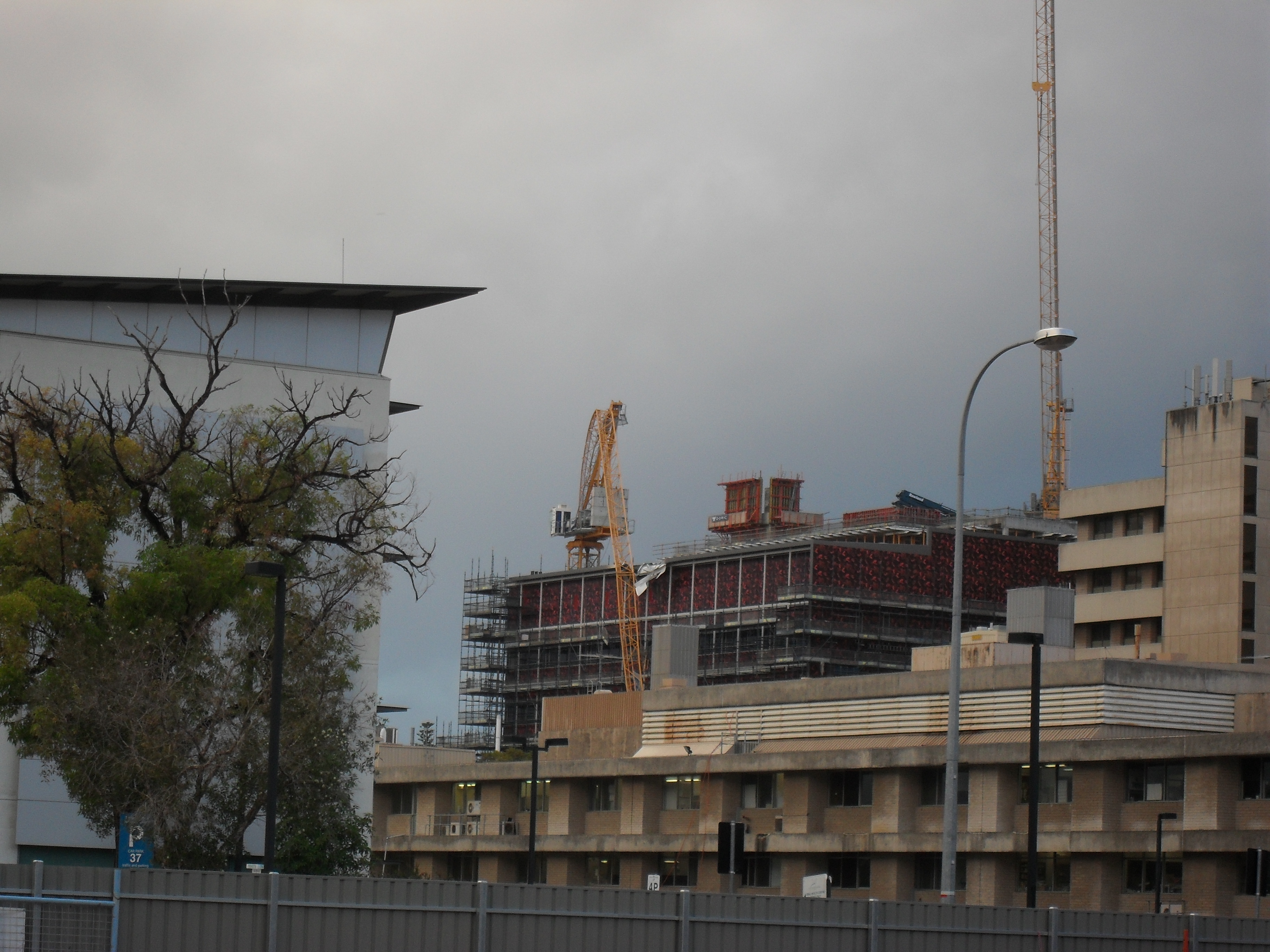
View from my Site Shed looking at collapsed tower crane on enighbouring build
nt and programmeing is required
In other news…has Chris W been let loose on the cranes in Perth (view from my site office looking out on the new cancer centre building). Strong winds in Perth, Western Australia, took the luffing jib of a tower crane over the back and onto the roof of a hospital on Sunday as winds as high as 140kph caused widespread damage to the region. While not yet fully confirmed we believe that the site was closed when the incident occurred and the crane was parked up with the jib at around 75 degrees and the slew brake left on, rather than the crane being allowed to ‘weathervane’.
Further Work
- Dewatering Programme Planning
- Environmental Monitoring
- Work on use of Stormwater System
- Post Tensioning Tender Review (awaiting for State to lift moratorium on all tenders…….long story!!)
- AER 3 – Dewatering, Health and Safety Paperwork and Boundary issues on Site, Relationship between Client, Existing hospital and JHG.
- TMR 2 Research – Project Bespoke Contract v NEC3/ICE 7th
First couple of weeks of June
Topics I have worked on
Controls systems – SSP user interface review, and RIID sensor location etc
In the past couple of weeks I have become much more involved with the control system on the two projects. Within the SSP this has involved reviewing the User Interface that has been produced by the controls subcontractor and comparing this with what is required and what is asked for in the specification. Of course all 3 of these are different, and so I had to try and come to a solution which will please the customer and not cost any more, (i.e. not vary far from the specification, and generally trade one step out to two steps back). It did bring it home quite how similar all control systems are; I could really see the value of the controls module we did, although I really wouldn’t want to write the ladder logic for this system. The crux of the situation is that the information is in the system, but the user interface is not displaying as required.
Within the RIID project I have been working with the contractor, subbies and Architects/Engineers to ensure the correct sensors are collecting the correct information from the correct locations. The shop drawings (which were previously accepted by the Corp, but also have the caveat that if we made a mistake it’s not our problem) vary from the design schematics at some points. The data that will be lost due to the differences has to be either classified as irrelevant anyway (something the designer is unwilling to do, in case they realise why it was important later on), or we need to extrapolate it out from other data or the suchlike.
In order to get the cycle of “construction > problem > question > answer” moving more quickly I convened a few different meetings with the various parties. I found that the Architects/Engineers, whilst being very intelligent and very quick on the uptake, find every question interesting and meriting further research, and so I had to keeping pushing hard to get back towards a triage mentality, as we had over 50 different issues to address. These worked well, as we managed to return 20 in 2 days, and assign 25 to further research, and pass the rest to more relevant POCs.
SSP – Squirty bottle inspection of sealant – keep it simple
Things are now very quiet in the smaller project of the SSP, as we are so close to completion, but also having to wait until the design variation has been approved and checked. We have occasional inspections, such as the inspection of the contractors-suggested-variation for sealing the pipe insulation ends, a good example of keeping things simple. The food coloured water was able to be wiped off – test pass!
CI’s Visit
As far as we are aware the CI’s visit went well. It has thrown up some interesting discussion for me and Matt to research, namely the possibility of doing some of the courses run by USACE for their engineers, as part of an induction to USACE process.
Of interest
Lines drawn in the sand, union interaction and quality of work.
There is some trouble continuing to rumble on site as the pipe fitters union is upset that the sheet metal workers are “encroaching” on their turf. This has happened due to the fact that the exhaust air from the high containment labs is piped rather than ducted, to give the highest level of containment possible. The sheet metal workers are responsible for all the air systems, and so have been fitting pipes where relevant. Clearly the pipe fitters union is upset that the work has not gone to them. At the moment the situation is stable, but it is an interesting study into the dynamics of unions. The quality of the work seems to be adequate in the most part.
Prices will always edge up – Corp holds onto small credit for negotiation, contractor places all costs in.
A couple of the problems that I have solved should have resulted in a small (few thousand dollars) credit, however due to the cost of chasing these credits no gain would be felt, so they are recorded for future haggling. When the contractor is given a variation they charge for everything they can, and as a result the cost of the project will always edge up, and of course the variations are excluded from the gain share pain share calculations.
And on the lighter side
Phosphorus in the sewage plant
We have been having problems recently with the local sewage plant accusing us of killing their “good bacteria” with too much phosphorus in the sewage. They have pointed the finger at our Fort Detrick by following the trail back to the camp gate, and then by deduction it was assumed to be the massive building site in the middle of camp. There was a lot of accusatory finger pointing as to who had been illegally dumping into the drains, until I pointed out that the storm water would likely have a lot of fertilizer in it. The Americans hadn’t thought of this as almost all of their systems keep storm water entirely separate from black water. On inspection there are some antiquated systems on camp that still have cross connections, so this seems to have explained the problem, and shifted the blame away from us. No idea how they are going to solve the phosphorus though… (Not my problem…)
Queens’s diamond jubilee party
Sarah and I hosted a Party to Celebrate the Queens Diamond Jubilee (which oddly enough isn’t a public holiday in America), and invited a good portion of the office round to our place. We had managed to buy-up pretty much every Union Jack Flag from across the states, and had them up everywhere in our house. I’m still not sure whether the guys though this was normal, or whether they were being polite by not laughing at the Red/White/Blue house. It went off well serving all the English traditions like cream teas, Pimms and slightly burnt BBQ.
My home brew
The first batch of home brew is almost ready… and I have already tried it: seems pretty good, but also quite heavy – not really a session beer (as I believe it is described).
Weeks 9 – 11. 28th May – 16th June 2012
Weeks 9 and 11.
It’s all “normal jogging” at the moment here in the Dyce office, with the following keeping me ticking over:
[Magnus] Glycol pressure relief system. Hugh (Programme Manager) and I worked through the Appraise and Select gates for this, and I’ve now kicked off the Define phase of the project with the WG PSN design house in Runcorn. Their piping, process and structural engineers will all work on the specified design piping design, whilst further contracting out the installation of Passive Fire Protection (PFP) to the glycol reboiler and heat exchangers. This new design must be executed during next year’s turnaround (TAR) window that starts 1 June 2013. During the TAR the whole platform is closed down, costing £m per day in lost revenue.
The pressure relief system is fairly simple in itself; a change from a 1” pipe to a 2” pipe. From the P&IDs (Piping and Instrument Diagrams) there is even a spare 2” nozzle to tap into, but looking at a photo (below) it’s not immediately clear where this is, and we may have to tap into the bridle instead. If I ever get offshore I may be able to have a look…
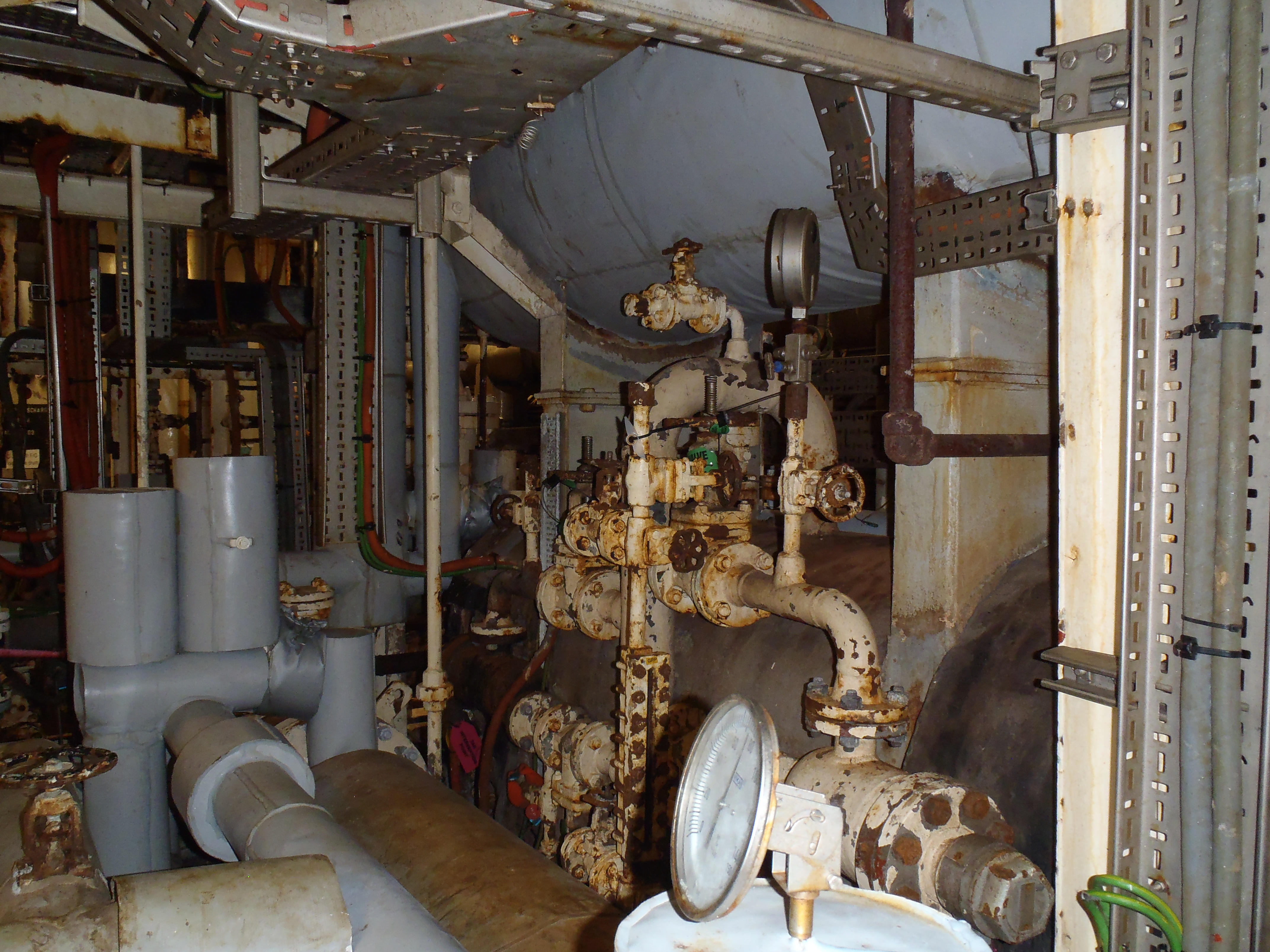
Figure 1. Glycol storage tank (below) and reboiler (above).
As the SPA for this, I ensure that WG PSN aren’t wasting time (£) producing nugatory work throughout the phase, and also grip them when things slow down. I report to Hugh and liaise with the TAR team – and do my bit to stop them from putting their noses in too much!
[Magnus] Installation of DBBs on the Condensate Pumps.
Just as the glycol pressure relief is required because it is currently ‘unsafe’ (if there was a fire, it’s calculated that the pressure increase in the boilers would be well above the design pressure and lead to catastrophic failure), the conde pumps are not SIRPS (Safe Isolation and Reinstatement of Plant) compliant, meaning that the pumps (the two conde pumps operate in parallel) cannot be taken off line without a complete train outage. So… some new valves need adding – simples! And it does seem pretty simple really! Because the installation will be conducted during the TAR, the trains will be fully bled and the new valves installed in place of the old ones. The new double block and bleed valves will allow for work to be done on the plant whilst the other part of the system remains leve
Is it really that easy? Of course not. The P&IDs show that the pipework is made of Incoloy 825, and so any new valves must be of the same material. Are these available off the shelf? Almost undoubtedly not, and so are a long lead item. One of my main deliverables at the kickoff meeting was to find the lead time for these – it might be that they are sourced and the pipework designed around them if the lead time is that long!
ETAP ALQ.
With the Appraise resting on a survey (recce), one may be mistaken that this would be a priority and a 6-week waiver given for my visit. But alas, the Offshore Installation Manager (OIM) hasn’t granted this. Cue a few terse e-mails from John (Programme Manager), and now we are just waiting for them to assess their priorities. Still, no rest for Warner – I’m digging further into the proposal and meeting the Renewals team leader tomorrow to see what “their plan” is. It may be that they’re either tackling it from another aspect (floatel) and we can tie in together for the business case. From a Plans point of view, all they really want from me is the broad brush of how much it will cost to install and operate. Wait out…
Magnus boom rests.
This is one of Ish’s I’ll be running with whilst he’s on Phase Four, and as far as I can see, currently consists of looking at big bits of steel meccanno which are being fabricated at a nearby workshop. Once complete they will be stuck on to some raised bolts on the platform’s floor and allow the cranes’ booms to rest upon them. Difficulties will involve ensuring they are manufactured to a tolerance of 5mm, and then lifting these 30-40m hunks of steel into place and bolting/welding them together. At some point in the next month I expect to have a formal handover of this project.
More work please
I’ve asked for more and will hopefully be getting some pipelines to work on. These are very good from an engineering side of things, and also (so John tells me) need to get done soon, which means I may get to see some of my work through to completion! We are looking at installation of these in November, so will be a fast turnaround.
Week 10 – Island Hopping (Scottish style)
Whist the South was suffering rain over the Jubilee Week, Liz and I took to the Inner Hebrides and had a week of uninterrupted sunshine! Did some good scrambling and walking, the occasional sea swim (not long til the big race) and then finished the holidays with the Lowe Alpine Mountain Marathon. I got back to work bronzed and rejuvenated (Liz got back to work shattered…)
Exploiting civvies…
If there’s one thing civvies do that the military don’t, its sponsor you! Maybe it’s because we’re all earning less money than they are, or maybe also because we find others’ challenges less impressive as we are all legends anyway, I don’t know, but the support I’ve had for my latest challenge (2.4 mile swim in a sea loch followed by a 125 mile cycle and culminating in a mountain marathon) is huge – complete strangers donating £50 and sending me e-mails of support! Check out the donations here: www.justgiving.com/chriswarner
Weeks 12,13 & 14 – Being the subcontractor is not fun anymore
First, I must apologise for not blogging of late. Work has turned into 16 hour days, 6 days a week and time has been a rare commodity. This has been caused primarily by the pile of s*!t that I have taken on having now fully moved across to the MOF project. To summarise this, an average engineer has 1 or 2 work packs/lots that they are solely responsible for. Over the last 4 weeks I have managed to pick up 7, yes 7 of the things, all of which are either unplanned, in disarray or have severe contractual issues. I am not complaining about this as i have gone from zero to hero and am one of the “go to” engineers on site if you need something doing. Also, I’ve started to enjoy it a bit more although listening to the wrath of the construction manager is getting a little tiresome every day as he attacks me about something that has happened before me taking over the reins. Out of public view though he often has a quiet chat expressing his gratitude for my efforts and that he knows how bad a situation I’ve been dropped into. Winning his trust has been a quick win and despite his dislike for me slowing things down to get it right first time, he acknowledges that I am the only engineer able to produce anything that doesn’t require a NCR (non-conformance report) produced after completion!
Week 12 was a classic week on the GLNG MOF; set unrealistic targets, fail to meet them and then look like idiots in front of the client. We (JHG) failed yet again to get our own house in order for the majority of our works with only 1 element of the works programme actually achieved which was the Bulk Aggregate Berth (BAB) approach slab. This is a 13x10m RC slab ranging from 400mm deep to 500mm to create a natural run-off. At the start of the week the civils crew were also asked to place 8 pile cages complete with tie bar joints installed. This was never going to happen as Bechtel would not sign off the cages due to the fact that a) they weren’t as per the submitted design, b) they had been welded without JHG having a weld procedure in place (12 months into a project!), c) the welds completed were not certified nor undertaken with a crayon or any other sort of quality control mechanism! The plot thickens even further into weeks 13 and 14.
My main other focus points were to complete the admin and direct on the electrical works and installation of a light pole footing, attempt to track down the status of procurement for all of my work lots and manage an issues tracker for the project. There are some serious issues!
Week 13 was a short week as at 1430 on Wednesday started a 5 day R&R break. However….on the Tuesday afternoon the construction manager called a snap meeting with the engineers and had decided that because we were so behind in our work and failing to meet any targets that our R&R had been cancelled. Brilliant I thought to myself and as he finished his speech, justifying what he’d decided upon, the floor was opened to discussion. After the awkward silence that followed I thought I’d take the lead and asked outright whether JHG were willing to refund my non-refundable accommodation costs, rugby tickets et al i had booked for the R&R. Following his silence he said he’d need to speak to the PM but I knew that they wouldn’t. Strangely enough I was told an hour later that i wouldn’t have to come in over the R&R! Whilst the opportunity was there I also got in my excuses for the rest of the R&R blocks as we’ve got plans for all of them…I think he was actually pleased to hear that one of us could actually plan!
The Wednesday was a cracking day though for not being able to pour a simple light pole footing. For the last few weeks there had been deliberation about the depth and placement of the mast anchor bolts but the mast designers were content. Ironically, only an hour before we were due to pour, the designers emailed to say that they were no longer happy and that we had to increase the embedment depth! Pour cancelled, desperate scrabble to find longer threaded bar or couplers only to realise that it was never going to happen. Even during the R&R this continued (some were working) only for the client to turn round and refuse to accept the pour as the couplers that had been procured were not galvanized and only 4.6 as oppose to the bar at 8.8 grade steel. How i chuckled to myself from a distance but this exactly what happens all of the time…rush, rush, rush to get the job done but not get the detail right. As I keep saying to my supervisor “if this was the army, men would die due to these decisions!”
So I took my R&R, although I came back very tired, and enjoyed the metropolis of Brisbane, saw the Welsh lose to the Wallabies and bagged a couple of dives to test my new kit.
Week 14 was mostly about damage limitation with the light pole debacle and issues with the pile cages. By the end of the week i was glad it was over for 2 reasons. First, only 1 of the 4 planned concrete pours happened due to the usual lack of attention to detail and secondly the hangover from the build up to the previous R&R was still hanging around like a bad smell. So why only one pour? Easy…the management team had not sent a design change to Bechtel 12 months ago when it happened and just as we were about to pour they called a halt to the proceedings. Net result is that we now need to wait for the design change to be approved by the Bechtel design team in Houston, Texas which typically takes 2 weeks. That explains 2 of the pours which were for the piles and tie bar joints. I was very frustrated by this.
The 4th pour was halted due to more “on the bus, off the bus” decision-making over the light pole mast anchor bolts. Hindsight is great as it turns out that my predecessor had been doing dodgy “verbal” deals with the Bechtel engineers about the attached distribution board slabs, failed to red-line any drawings for submission and had we proceeded would have been in a world of pain as elements had been omitted that weren’t actually authorised to. Key learning point for Serevena the engineer, trust no-one, check everything 3 times and make sure that all of these “dodgy deals” are in black and white before proceeding.
So the above covers the main bits out of 2 of my work lots. The other 5 are potentially equally as well flawed so stay posted. The client wishes they never hired us (JHG), the JHG engineers all want to leave and the project has just announce a delayed completion date to the tune of 44 days, from August to mid-October. If this project is finished before I leave in early December I would be very surprised and may need to eat humble pie.
There are some positives though. I’m getting loads of good commercial experience, problem solving and covering most of the DOs fairly well. I actually enjoy the challenge of it all but most importantly is that the civils crew (my mob) are now the go-to team on the project which generally means I get the engineer lead, giving me the opportunity to shine. The senior project engineer has told me he’d employ me in a heart beat which was nice although I did have to remind him of my day job and it’s contract!
Apart from work, Team Serevena are all well. Baby Harrison is now 7 weeks old and we almost have a UK birth certificate for him which means we can apply for a passport, visa, etc. Austyn has moved up to level 2 in swimming lessons and can do doggy paddle (well), front crawl (badly), breast stroke (almost) and back stroke (lazily). Elliot talks complete gibberish as he tries to make sentences and is currently trying to master Tyrannosaurus rex but comes out with dinosaurus rex! Lisa is coping, looking after 4 boys (I include myself in that) is taking its toll but she’s heroically fighting through. Finally, Blaze is back on her feet at my parents following the trials and tribulations of losing Jackson and her whelping and is going for a week-long camping holiday to Scotland. Lucky girl!
That’s all folks.
2 Months In
Hi everyone. This is a shamelessly AER focused post so please feel free to lambast me for my dryness. Lambast me baby! More interesting (picture based) posts to follow shortly…
Here are just a few of my general experiences and observations from the first 2 months on site. I’ll do more on the technical nitty-gritty of the tasks over the next few weeks.
Experience: Updated Roles and Responsibilities
So, I’ve picked up a few extra responsibilities over the last few weeks; I’m now Services coordinator for all Public and Public/Private Shared facilities, Site Supervisor for two discrete projects, and the Services Defects Manager for all areas of the Programme already completed but still within their defects liability period. Sir John is certainly getting his dollars’ worth out of DDK.
On the public/shared side of the site, that means I’m overseeing the coordination of services in a surgical day procedures unit, a theatre recovery ward, a catheter laboratory (more on which later), a new kitchen, a medical records and training facility, a supplementary services (chapel, AV etc.) unit, a central energy building, and a heat distribution plant room. All of these involve refurbishment or expansion, and so working around other live services and, mostly, in areas where patients are still being treated.
Observation: The moto in all of this is very much hospital first and, as the hospital seems to have a pretty much zero tolerance approach to any disruption what so ever, this means anything that affects a hospital service or operation, generally occurs at midnight or on a Sunday, or (and this is my favourite) both.
Analysis: It might seem that the programme planners were rather short sited in developing this strategy; the CI remarked that it would probably have been a lot cheaper to simply build a new hospital next door and then knock down the old one. It is certainly true that the cost of the constant frustration of progress, because of the need to work out of hours, is significant; the hourly labour rates, probably the most expensive element of any work packet I’ve been involved in so far, doubles as soon as 4pm passes.
The reason is threefold:
1. There is no space. The city of Joondalup, and the suburbs around it, are expanding so fast (in no small part driven by the influx of Irish, Spanish, Italian, and British workers fleeing the hopeless prospects in Euroupe, lending Joondalup its nickname of ‘Pom City’) that there is simply no space to build a new hospital other than inside the old one.
2. Australia does not have publicly funded hospitals in the same way the UK does. Many facilities in the existing hospital are privately owned and funded. No one would pay to replace or relocate them, when they are perfectly profitable where they are.
3. Each ward or facility is in fact a business in its own right. When the refurbishment of one affects the operation of another, there may be significant compensation claims. As such the hospital’s operator, Ramsey Health Care, is particularly unwilling to sanction any interference with business as usual, unless it absolutely can’t be avoided. With each patient paying, on average, $1000 a day, not to mention the everyday exigencies of any hospital, the choice between closing beds and making builders work overnight is a simple one.
The bottom line is that it’s too difficult, and too expensive (to individual business units) to do anything other than refurbish and expand the hospital from the inside out.
Experience: I’m also the site supervisor, normally a role given to a bricks and sticks man, for the Central Energy Building and the Heating Plant Room. This means that in addition to coordinating the services, I’m also supervising and coordinating all of the civil (not that much) and general building works.
Whilst the civil and building things I’m involved in aren’t particularly technical – we have consultants for that – they come in tremendous volume, and I’m having to learn about slab, column & beam construction, sub base properties, and general building techniques and practice. The civil training we E&Ms get at the RSME is very useful here, but more knowledge of the difference between an PFC and a Z Purlin, for example, would be useful to us.
Analysis: Perhaps the steepest part of my learning curve has been to do with simply understanding what it is that the consultants and contractors are talking about. Whether talking about an purlin, a reveal, or a bulkhead, there is a good deal of terminology, that any engineer, regardless of discipline, needs to be conversant with.
Recommendation: I have found that 2 books have been invaluable as desk guides. First is the Building Services Pocket Book, published by Newnes. This is a very good practical guide to services in any building; focusing on mechanical services – which I now know dictate the design of all high level services layouts – it offers invaluable notes and is simple to understand in a hurry. The second is the Architect’s Handbook, published by the Architectural Press, which is an excellent general guide to building. I’ve also see the Building Construction Hand Book, published by Butterworth-Heinemann, but this is a little basic compared to the other two. I would recommend that all students on PET be issued with the first two books, or something similar. Alternative suggestions anyone?
Experience: Finally, as the Services Defects Manager, I’m responsible for receiving, understanding, and assigning the Client’s defects notifications, as well as identifying many of them myself. I rather walked into this job, as I found so many defect as I walked around the place, that it became easier to deal with them myself than to staff them to someone else.
Analysis: Essential to doing this properly is the ability to compare what is in from of you with the drawings. I have found that it has taken me a few months to understand, quickly, the myriad of technical drawings that are encountered on a construction site. Because the difference between a quick and amicable solution and a protracted and increasingly entrenched e-mail rally often lies in understanding the drawings and specification the fastest, the ability to rapidly interpret technical drawings would enhance the preparedness of PET students for Phase 2 work.
Recommendation: More technical drawing comprehension should be incorporated into phase 1; everything from the EWIS to the structural steel. I have plenty of PDF example drawing that could be used to set such exercises and can send them if required.
And Finally: In an effort to prevent this from being the driest post since, well ever, here are some pictures of the weather in Perth over the last few days – get it? ‘Dry’? Yack yack!


And worse is forcast for tomorrow – last week it was 30 and sunny?!?
 Holdfast Training Services Trial Blog