Archive
Greg would have a field day!
The last blog saw me having a few issues identifying the contract that was in place for the £1.2 million of waterproof membrane which we will be spraying in permanent works beginning on the 3rd Jun 14.. Turns out there wasn’t one…
I am determined not to use this blog to drip about the complete mismanagement of this process…I’m beginning to bore myself. So instead I will detail some of what I’ve learnt and try to tease out what John would call, ‘CPR gold’.
1. Statement of Requirement. The specification designed by the MottMacDonald Ltd is linked here. 16 Section KW20 Materials and Workmanship Specification – Spray Applied Waterproofing Membrane Systems for SCL Works
The performance requirements are at para KW20.1301, and Table KW20-03 in the appendix. In outline they pertain to bonding properties, permeability, crack bridging and flammability.
2. Preferred suppliers. In the beginning, 4 chemical materials companies were under consideration. I hesistate to use the term preferred suppliers, as there is a slight nuance here.
a. Subcontractors. Blokes doings things with kit and materials. The Joint Venture will invite subcontractors to tender for work, using this website. Designed for use at the Olympics, it has become industry standard for major capital contracts to ensure transparency. Subcontractors then accept the invite and are added to a list ahead of a commercial comparison, eventually leading to a subcontract, in this instance in the form of NEC.
b. Suppliers. Just stuff. A materials requisition report is raised from BFK and sent to a list of suppliers. This process is much less transparent and very much favours older, larger, richer and more established companies. It follows a process reliant on old contacts and who we have used before, combined with a quick Google search. We let them know we are looking, and suppliers then tender for the work, are compared, and a decision is made culminating in a supply order.
For the waterproof membrane, we are in a very grey area. In essence, we are ordering material alone, which should put us in point 2b territory. However, we are also hiring their machine to apply it AND getting a techical expert to train us. This training really should stray no further than the classroom, but he is already operating underground…applying the material in a trial tunnel…that is in fact going to be a cross passage…that will be inspected and signed off as permanent works. This strikes me as a professional service and one which should be protected by the assurances commensurate with a subcontract.
3. Commercial Comparison. The four chosen suppliers then underwent a commercial comparison, the output of which is here: Commercial Comparison. The churn of people in this place is such that the people that were involved have all left, so I have tried to pick out the decision making process (I’ve hidden the names to product their commercial modesty so if you’re having trouble sleeping, play along at home and see if you can work out who we went with.
a. Specification. Clearly, the first criteria test is if your product meets the spec.Although all state they can, one was unable to prove it. The eagle eyed will note than one actually does not meet the spec on permeability. His waterproofing is not waterproof which you would have thought would have harmed his chances…
b. Experience. Previous case studies are all important, and if you can say that your product has been used successfully on previous high profile projects, it will stand you in good stead. Additionally, the tunneling fraternity is quite small so it is likely that some of those making the decision will have worked on those jobs. Definitely the case here, and you will note on this critieria, one supplier is the clear winner.
c. Cost. I remember Greg saying that the cheapest and most expensive tenders are often stripped away straight off the bat. In this instance the most expensive is prohibitively so, and as such put himself out of the running. Although the original budget is lost in the mists of time, we are now looking at projected costs for this work for the purposes of the materials requistion.
d. Add Ons. In order to further mitigate risk, the supplier may offer supervsion, training WITH accredition and ongoing technical support. For us here, this is critical. There is very little knowledge on the product or the equipment.
How did you get on? Hopefully you all went with Supplier 3…BASF with MasterSeal 345… because we did and its too late now. The irony is however, we’d already signed up to the automated machine…the Logica….BASF owned which can only use the BASF products so it seems this process was slightly moot.
In other news,
Thermal Trials. The thermal imaging trial has rolled out on site this week. Feedback was positive, and having delivered a number of ‘toolbox talks’ it is reassuring to note that much like your average Sapper, the miners were really only interested in how expensive the kit was. I am awaiting data feedback, but check out this footage of the shotcrete being applied to the crown of a tunnel.
Note:
1. The shotcrete begins to react in the air immediately on leaving the nozzle. Note, the reaction as it accelerates when on the surface…its is easy to see the contrast with the cooler concrete, which will immediately identify concrete which is not curing and thus areas of risk
2. The rebound (waste) actually amounts to quite a bit. In the dust of the tunnel this is often not noticed to such an extent.
Rugger. I turned out for the Joint Venture v CrossRail(and ringers) at the hallowed turf of the Honourable Artillery Company ground in Moorgate. After some pretty fruity tackling interspersed with moments of sublime and ridiculous, we ground out a 10-5 victory. Check out the first 5 mins…you will note my slick hands, sublime running lines and stonewall tackling are mainly obsured by a fat bald bloke in a wifebeater.
The Rise (and Fall) of the Machines
My main focus over the last two weeks has been the planning and execution of the trials of the water proof membrane layer of the Sprayed Concrete Lining tunnels. Following the application of the initial layer of spray concrete (min 75mm), which stabilises and regulates the substrate, the primary layer (between 250mm and 350mm) , which is comprised of the same concrete mix, with steel fibre reinforcement to provide the main structural element of the tunnel the waterproof membrane is applied. This will subsequently be ‘sandwiched’ by secondary layer and finally a surface layer which I will not discuss here. See drawings Typical Lining and Thicknesses
The ‘Eye of Sauron’ is now on this section of the works, and I have lost count of the amount of times the client side have reminded me that we dont want to be standing on the platform in a few years time next to a bucket catching the drips from the lining. The chemical is polyurethane based, and is delivered as a white powder in 20kg bags. Designed to be used in hand or spray application, the powder is mixed with water and applied to the lining as a paste, which then cures to a material of the texture of a hard rubber. The lining is applied to a thickness of 4mm, which leaves a smooth and shiny finish.
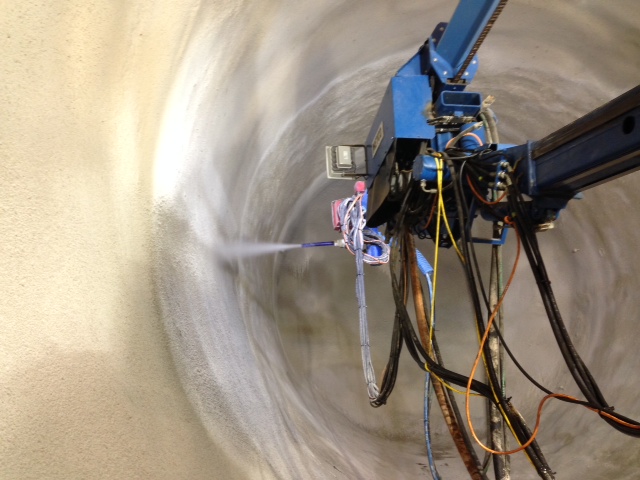
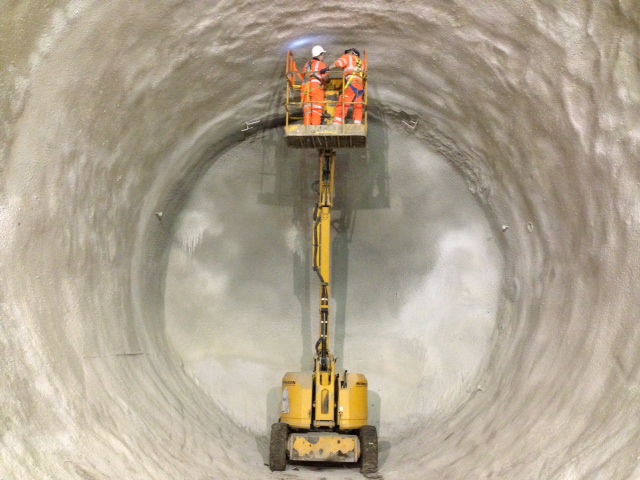
Logica spraying MasterSeal (Top)
Inspection of MasterSeal layer for compliance, alongside MottMac Designers (bottom)
Concurrently, a spray application machine known as the Logica has been procured from BASF, one of the suppliers of waterproof membrane. This machine not only doubles the rate of production, but minimises wastage by its ability to automatically spray to a pre programmed profile. The trial of this machiine was observed by a number of nozzlemen who obviously felt consigned to the stoneage! However, the procurement of material and machine have thrown up a number of interesting contractual notes.
ISSUES
1. Logica.
A flat bed lorry carrying a hose arragement designed to attach to a spray concrete delivery system, applying upto 20m3/hr of concrete to the walls. Much the same as a system that already exists on site, uniquely it is has an on board automated survey system allowing it to scan a the profile of the tunnel, then apply material to a consistent thickness. Manufactured by MeyCo in Switzerland there are only 5 operational units in the world. BASF purchased one, and are seeking to procure a second. (This is important later.)
The BFK JV deemed it appropriate to rent this machine to apply the waterproof membrane across all SCL sites. A smart move given that 373tonnes are required, not including tolerances or wastage. BASF now lease the vehicleto us at a flat rate of £12500/month. The delivery to site and subsequent testing and approval then became my issue.
For someone who has now embraced Whole Fleet Management, and a few headaches aside, been impressed, I was astionished at how little we got for our money. The vehicle turned up at site having been ‘refurbished’ Despite having been given a thorough wash and wax, it immediately became clear that this had not happened , as I quickly found myself replacing water pipes and watching the replacement of a hydraulic ram on the boom. Clearly the machine had not been run up at all before delivery.
Secondly, and mainly due to the unique nature of the machine the corporate knowledge for operation is almost nil, even with BASF. It is all contained witin the head of an Austrian fellow called Kristian, who lives, conveniently, in the Faroe Islands! He nursed the machine back to life over the course of a day and night and we were back in business and now the best of friends (although I strongly suspect he may be an android!)
So….the program for waterproofing and secondary lining is now solely reliant on 1 machine, and 1 man. More to follow
2. MasterSeal.
The BASF branded waterproof membrane product. By far the most expensive element of the tunnel lining, and the the 373 tonnes will cost us just shy of £1.3million. Not only that, it is manufactured in the States and comes with a 6 week lead time. Additionally it will arrive in 20ft shipping containers, and since space on site is at a premium it certainly wont be stored here. But surely, considering the size of this order, all this will have been thought about? See below…
WHAT HAVE I DONE?
Considering the issues surrounding the vehicle, I sought out the contract to establish a what we could expect from BASF. There wasn’t one. The best I came up with was a Plant Hire Order detailing the quote and generic T&Cs. A bit more investigation found the initial invoice with an attached, generic contract from BASF which amongst other things told us that it was our perks to repair and maintain this machine AT OUR COST!
Given the lack of knowledge I organised the nozzlemen and fitters (M&E) to udergo familiarisation training at the beginning of each shift to try to mitigate the reliance on one Faroe Islander. Having directed this on the Friday, I expected 3 of the 4 shifts to have been trained by the Monday morning. Most were pulled away elsewhere !!!
Neatly slipped into the T&Cs was a clause that dictated the Logica was only to be used with BASF products…ie MasterSeal. This clearly makes it difficult to conduct a fair and objective commercial assessment of suppliers as it seems the horse has already bolted.
So based on this newly found knowledge, and a serious indicator in the fact that BASF are the only supplier seemingly in the race, I began to look into how the order was progressing. Again, there wasn’t one.
Next, I collated all the site programs, and established that the Fisher Street site intend to begin spraying waterproof membrane on 3 Jun 14, meaning that with the lead time for deliver plus a weeks contingency, the last safe moment to order this stuff is 14 Apr 14…11 days from now.
Thus, and in a mild panic by this stage, I returned to the commercial team to discuss lead times on the procurement process on an order so large. I was told and average of 2-3 months. Red Card moment.
REFLECTIONS
It seems that a limited Commercial Assessment was done in July of last year which compared 4 suppliers. BASF were preferred almost immediately despite being 2nd most expensive, as they could provide a better level of technical support, with the added sweetner of the Logica. However, since that point, nobody has been repsonsible for this section of work. This speaks to wider issueS at BFK which is thematic across the project.
Communication. Despite everybody being cognascent of the importance of this section of works, a robust plan has not been considered, resourced and properly tasked. This lack of proper tasking is exacerbated by the retincence of people to take responsibility for execution. Below senior management there is very little accountability. In this example, the commercial team have done a bit, and the construction team have done a bit and the whole process has been bounced around before being completely dropped. There is now NCO equivalent who seeks an intent, follows an endorsed scheme of manouevre, and is accountable for achieving an endstate.
So after a series of polite prompts, I presented all this to my line manager and said, we need to get this order completed, supported by a robust contractual agreement which details ongoing maintenance and technical support, and includes a training program for the guys, and guaranteed delivery times and storage for the product…and we need it yesterday. I was told ‘Ok…we best do that then…’
Any ideas??
To me there seem to be a number of fundamental conflicts that are thematic across the advance sequence during the SCL works that I am eager to hear your collective thoughts on.
Overview
In outline, SCL works in the station caverns focus on widening the 6m tunnels bored by the Tunnel Boring Machine into 10m diameter platform, concourse or cross tunnels. Tunnels are excavated and then rapidly sprayed with concrete to stabilise them and use as the initial lining of the tunnel. See this time lapse to give the idea:
http://www.youtube.com/watch?v=cAWAIwf3nOY
The construction sequence from the method statement is, in basic terms, as follows:
Tunnel Elevation Sketch
1. Excavate top heading to profile, and to 1m chainage. Engineer utilises pre programmed total station to guide plant operator.
2. Initial SCL layer is sprayed to a minimum of 75mm to all exposed ground to seal. Test panel is then sprayed to confirm entry to the exclusion zone in the proximity of freshly sprayed concrete. Using a penetromenter test, a compressive strength of at least 0.5N/mm2 must be verified before personnel enter the exclusion zone.
3. A second top heading of 1m excavated as per point 1. SCL later sprayed in the same way. Critically this means that the engineer, plant operator, nozzlemen and shift geological engineer will move forward into the exclusion zone, and underneath the ‘freshly’ sprayed concrete, albeit not until 0.5N/mm2 is achieved.
4. Spoil in invert removed, and battered to allow access to full profile. Larger tunnels will excavated bench then invert in two stages. SCL sprayed to complete full profile.
NB. This sequence is in basic terms. A number of other activities are conducted pertaining to water management, joint preparation, spoil removal etc. I will not cover these here.
Issues
Three key risks strike me here:
1. Technical.
The spray concrete in the crown of the tunnel is not actually tested for its early age strength. An assumption is made that the concrete on the substrate is behaving as that in the panel. It has been noted by the miners that often the concrete on the wall cures slower than that in the timber test panel (perhaps the clay has a cooling effect, the act of spraying the substrate causes cooling, or indeed the exposed clay is cooler than the ambient temp????)
Penetrometer tests are often conducted in the wall but as it is difficult to reach the crown without getting underneath it, it is not done. As the crown is the last to be sprayed and therefore (probably) the last to cure, this assumption based on the panel strikes mean as not robust?
2. Managerial
Miners are incentivised by a bonus scheme based predominantly on progress. Their base daily salary is around £300 per shift. There is a further £200-£250 bonus if you advance 4m per shift. Any less than that and the bonus is reduced proportionally. Thus the gangs are at full throttle and any reduction in production needs to be a critical requirement or else you will hear about it. Due to the opportunities currently available for qualified miners and nozzlemen, they slightly have the contractor over a barrel here, and if the bonuses were to be reduced or altered, they are likely to go elsewhere.
The shift engineer, from what I can see almost always fits the cliche…young timid graduate who is there to be seen and not heard…but take the rap when it goes wrong. The relationships with the shift pit boss (think grisly SSM) and the lads are limited. The shift patterns are deonflicted meaning that engineers don’t often work with the same gang and therefore their rapport and mutual understanding is limited. It means that it is a significant challenge for the engineer to direct, lead the shift, particularly if he is seeking to slow the rate of advance for say, quality purposes. Its probably fair to say that the engineers are often rushed to keep testing the panel so that the instant 0.5N/mm2 is recorded the advance continues.
3. Health & Safety
Fallout from the crown are relatively regular (very approx 1 per week). Fallout should be reported as a near miss. However, the miners are very wary of reporting these incident, due to its perceived impact on progres for that shift, and any ramifications and blame. Clearly a certain element of discretion has to be exercised, and if the exclusion zone is enforced nobody should be near it. However, it could suggest a wider weakness in the lining.
Solution
I feel that there must be a way of removing the element of assumption from the compressive strength test in the crown, and that the test panel penetrometer need to be augmented with a reliable test that is quick to conduct safely, such that it gets buy in from the guys on site. Having used thermal imaging technology quite extensively in reconnaissance, I though perhaps there is a way of using it here. Having spoken to my line manager it, turns out that there are already products on the market that can test temperature at range, and he was one step ahead of me having arranged a visit from an old mucker of his at Warwick University…a doctor of engineering who has agreed to conduct testing on remote equipment to deliver a TI image of the curing concrete, identify temperature and translate it into an estimate of early age strength in the crown. Im going to get involved in this, with one eye on a TMR, butahead of seeing any results I remain unconvinced. Therefore really keen to hear any inspirational ideas of reducing this risk in the short term that I can cynically take as my own?
The bonus culture, and the fundamental conflict of interest it delivers on site remains an issue. My suggestion of associating the bonus with quality rather than rate of advance was largely dismissed as ‘not what happens…the lads will just find another job’. Not letting this one go…
Keen to hear your thoughts!
My tunnel is too tight….
One thing that has struck me since joining CrossRail is that the opportunities for innuendo bingo are legion. I will not recount the most memerable examples here, but I encourage you through the medium of my blog to play along at home.
So after almost two weeks held in reserve, up in the main office at Hanover Square, I was unleashed on an unsuspecting site at Tottenham Court Road. Now I would like to think that coach put me in due to my obvious concrete competancy, but I fear it was much to do with a calender clash that distracted almost everyone else on the team. Turns out Friday, was the annual Concrete Society Dinner…a social event only just overshadowed by the Oscars this weekend….
The running tunnels, cross passages and concourses have all received their initial and primary sprayed concrete layers. Initial lining is utilised to protect and prime the excavated surface and is sprayed to thickness of approx 75mm. The primary layer contains steel fibre reinforcement and provides the main structural integrity of the tunnel, and runs to a thickness of 450mm. Following that, the surface requires regulation and preparation in order to cover rogure steel fibres that are likely to damage the subsequent waterproofing layer. This is acheived by spraying a finer aggregate layer. Or so we thought…..
I stepped in to take over the workss which had been programmed and planned…allegedly. Predictably I arrived at site to find that nobody down there had been briefed and the concrete hadnt been ordered! Difficult to spray concrete, I find, without, er, concrete…
After many an hour listening to a load of Irishmen shouting at each other we finally began to spray. The Potenza spray machine…essentially a large hose mounted on a pickup truck, which allows regulation of flow rate. This brings about a quality management point. The nozzlemen…Spr Bloggs as we would know him…want to spray at the max rate of 20-22m3/hr. He gets a bonus per advance/chainage completed in his shift. Understandable. However, this flow rate increases the chances of rebound. Exactly as it sounds, the concrete does not adhere readily to the substrate causing dimished strength.
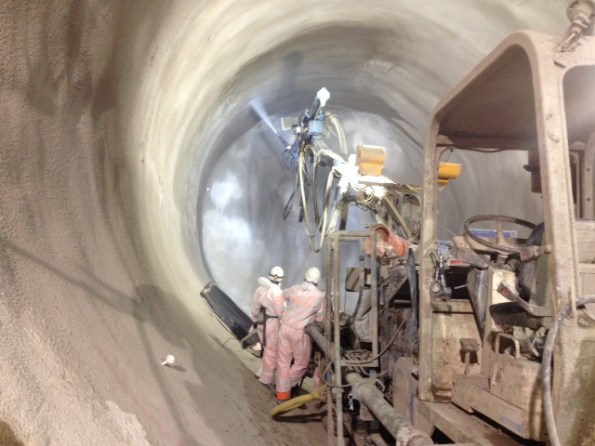
This brings about a quality management point. The nozzlemen…Spr Bloggs as we would know him…want to spray at the max rate of 20-22m3/hr. He gets a bonus per advance/chainage completed in his shift. Understandable. However, this flow rate increases the chances of rebound. Exactly as it sounds, the concrete does not adhere readily to the substrate causing dimished strength. Test panels that are sprayed, then cut into beams, highlight band layers which reduce the flexural strength by creating failure plains
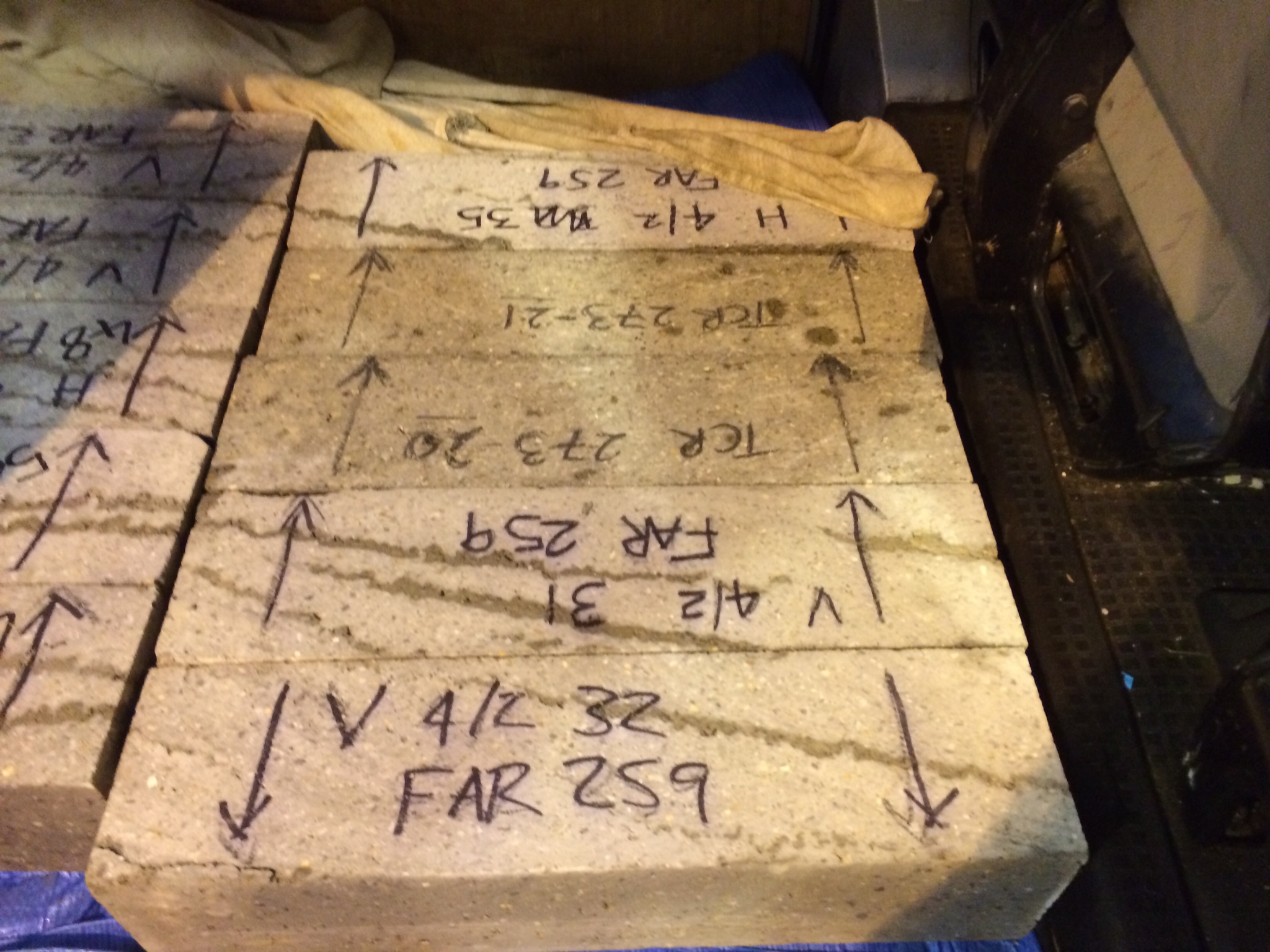
Note: TCR=Tottenham Court Road, no band layers. Far = Farringdon, band layers. Inconsistent quality assurance across sites is future blog fodder…look forward to that!
On completion of the regulating layer spraying, I returned to inspect. It was immediately clear that things hadnt gone well. The surface was particularly poor, and contained craters caused by large aggregate. The reg layer is supposed to be a finer aggregate so it was immediately clear that there was an issue with the batch
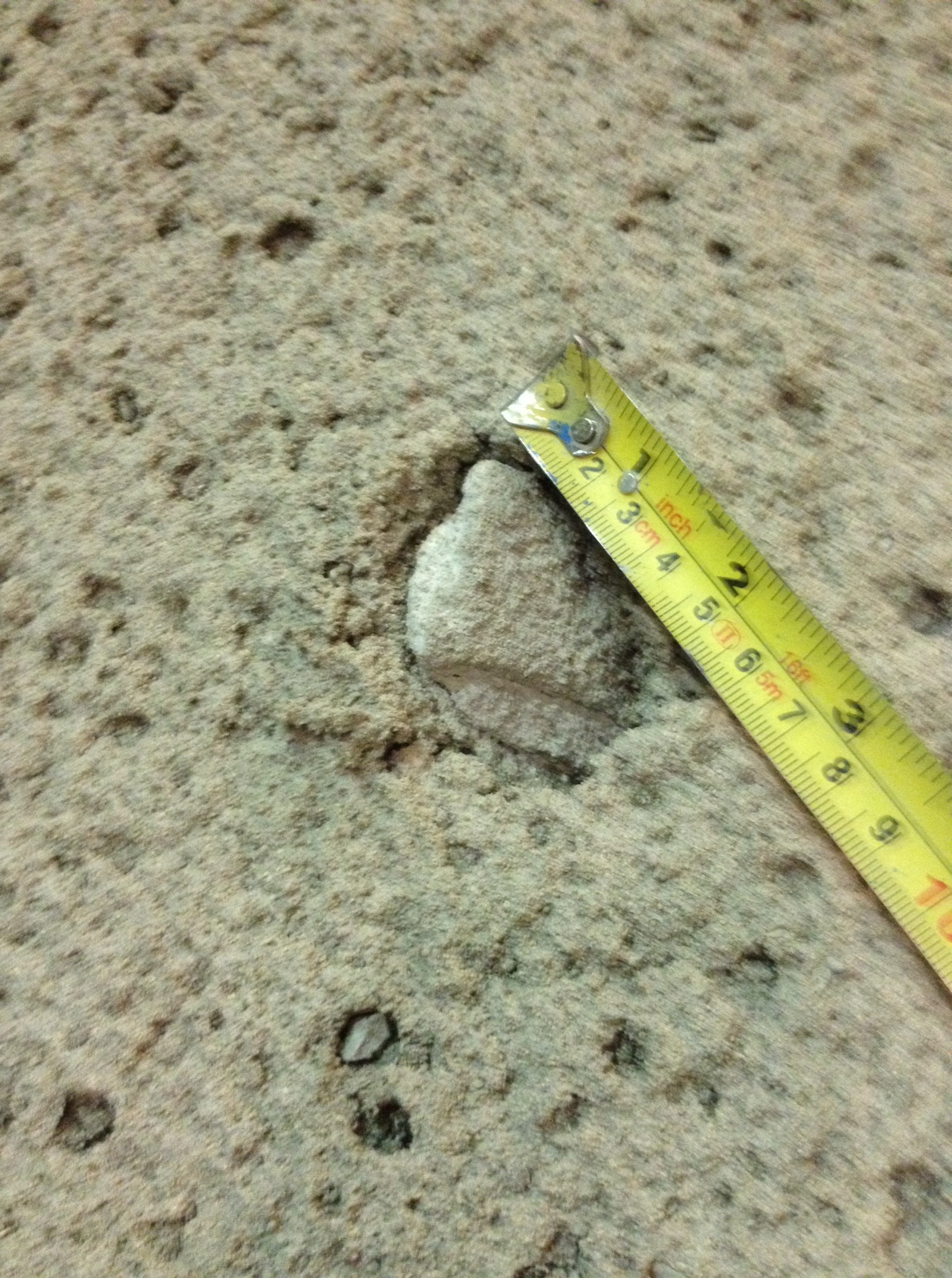

After some digging, a number of issues came to light surrounding the concrete contractor, Hanson.
1. The core contractual terms dictate that when concrete is ordered from site, it must be batched within 50mins and sent immediately to site, where the lorry is tracked. However, this does not apply to concrete used for trial which is outwith of the core contract meaning the contractor can effectively send it when he’s ready. Over six hours later in this case. When our first batch arrived at site, it was flow tested and failed arguably due to too long in the wagon.
2. Quality control. It seems that the batches were contaminated at the plant with a larger aggregate, whihc presently is unexplained. From our perspective this is frustrating. The mistake has managed to creep past the initial batcher, aswell as our liason guy at the plant (whose job is precisilt designed to prevent this!). Additionally, when it was receipted on site and tested (temp and flow) it was again not picked up.
As a lessons learnt, we will now have an SCL rep on the surface to oversee receipt of the batch. When a sample is taken, it will be poured into a bucket through a sieve as an additional check to confirm aggregate size.
Next up are the trials of the waterproofing layer, which is entirely my baby. I wrote and admin instruction and distributed it yesterday with a number of taskers. Its raised a number of eyebrows, as it doesnt seem to be the done thing to communicate with each other around here. Granted, due to my poor understanding of the hierarchy, I did effectively task CrossRails Chief of Staff! How to win friends etc….
Europe’s biggest construction project…no biggie!
Following a period of leave, which I mostly spent in a darkened room recovering from the Phase 1 onslaught, I joined the CrossRail project as part of the BamFerrovialKier (BFK) Joint Venture.
Proposed as one of the most significant construction projects ever undertaken in the UK, CrossRail is designed to increase rail capacity in London by 10%, slashing journey times and bringing large areas of regeneration. The route will run over 100km from Maindenhead and Heathrow in the west through to Shenfield and Abbey Wood in the east.
The route will incorporate 38 stations, 9 of which will be new builds and a number more will receive signifincant upgrades. Approximately 1.5million people will be brought within 45minutes of central London and the route allignment is designed to connect the city’s key emplyment, leisure and business districts.
The Crossrail Act 2008 formalised CrossRail Plc to act as the ‘client’ and is in effect Transport for London under another name. The scale of the project ensured that separate contracts were let which defined discrete elements of the overall build. The construction program in outline is shown here, if you’re having trouble sleeping, so I won’t go into it any further!
Crossrail let a number of contracts to the BFK JV which largely comprised work at 4 locations: Bond Street, Tottenham Court Road and Farringdon stations, aswell as an maintenance and emergency escape shaft at Fisher Street (where Mike Burton made his name!) bfk stations
In outline, and very basically, the contracts hierarchy is as follows Contractual Relationships. The contracts are all NEC3 forms of contract which offer inherent protection to the many small contractors which work for BFK. The contractual relationship with CrossRail Plc, acting as the client is ‘target cost’, but one in which CrossRail has added a number of ‘Z’ Clauses which make it one of the most onerous that the QS team here has seen. According to the Kerry, the AQS here BFK have taken it on the chin in order to secure the contract, but it is looking highly likely that they will make a loss come the end of the project. As an aside, Kerry is not only a commercial ninja, she is also devastatingly attractive. Whilst Greg is clearly a ruggedly handsome man, I am suddenly very interested in the contractual considerations of the CrossRail project……
Coming right down to my level, at the coalface, I’ve been attached to the Sprayed Concrete Lining (SCL) team in the Head Office at Hanover Square. SCL will be used to stabilise the ground around the platform tunnels, cross tunnels and main concourses at each station location. Sprayed concrete is a mixture of cement, aggregate, admixtures, accelerators and water projected at high velocity from a nozzle which will produce a mass directly applied to the substrate. For the CrossRail tunnels, a number of layers will be sprayed, which include a primary and secondary later, regulating layers and waterproofing. Each layer is dictated by a different specification and a bespoke mix must be developed tested and endorsed by CrossRail.
Astonishingly, these mix designs aren’t yet in place with the exception of the primary layer. The ‘Eye of Sauron’ has turned on the massively undergunned SCL team, who I think are hoping that I may be their saviour. Little do they realise that I was too busy shovelling Mrs Hoopers home baking into my face to pay much attention to the concrete lectures. Sorry Richard!
So my role will intially comprise of running the concrete testing procedures in order to get the Material Compliance Reports endorsed ahead of spraying the secondary lining. Look forward to some good TMR fodder related to why the mixes are repeatedly failing due to low fibre content, and poor flexural strength. Following the acceptance, I’ll be managing the spraying at Tottenham Court Road ahead of moving down to Farringdon later in the year.
 Holdfast Training Services Trial Blog