Archive
A quick update
Tower Crane
The good news is that the tower crane got successfully installed on Saturday and Sunday, the construction went very smoothly and though long days the Red and White livery of the crane in John Holland stands out against all the yellow cranes across Perth.
What this does mask is a drama with the strength of the concrete which led to lot of running around. The pile cap design required a strength of 30 Mpa, however 3 and 6 day test cylinder strengths were 16 Mpa and 23 Mpa accordingly. This result of the 6 day test was delivered at 12pm on the Friday. This resulted in the requirement for some urgent core samples to be taken from the pile cap. Fortunately the lab stayed open for us and the results came in at an average of 30.5Mpa….phew…..at this point half of the site had been shut and a 250tonne crane was on site. If the installation had been delayed it would have been costly!!
Stair Core 3
The reason for the ridiculous number of piles in Stair Core 3 has not been driven by the loads but by an error in design (a problem made worse by construction being so close to completed design). I can’t write too much as this is the subject of an ongoing investigation and litigation but it seems there were number of errors in the design calcs which under designed the initial piles. This resulted in the extra piles which you can see. Stair core 4 carries a similar amount of load but you will see has much fewer piles.
Of note – a frequent cry from sub contractors is the level of overdesign and redundancy being specified in the design, Often I will hear the sub contractors saying they have not seen such a large pile cap or pile with so much reinforcement. A lot of this is driven by the requirement to be the last building standing in the case of a natural disaster and the seismic loading!!
PT/TMJs
The post tender interviews went well – I was assisted by the works package manager in the end which was helpful as both our brains were fried after repeating the same meeting 3 times. The major contentious issue is the supply and install of Temporary Movement Joint shear connectors. All 3 PT sub contractors complained bitterly that they were not the right sub contractor to install these items. (The value of these items is now about 50% of the overall contract value)
The reason why these have been included is that they were never included in the superstructure works package scope and John Holland are trying to do a regain by slipping this $1,000,000 extra into the PT works Package (another ball dropping moment from the procurement team).
Concreting in the heat
Being in a hot climate and seeing as where the Corps is building at the moment I took the opportunity to attend a lecture by the Institute of Concrete yesterday on “Beating the Heat –Concreting in extreme temperatures.”
This may well ensure that I spend the rest of my career in the wilds of Scotland or Norway or some such cold place but I learnt loads. From simple wins like the best way to cool the concrete is to cool the aggregate by spraying with water and shading the aggregate prior to use. To the sci fi method of using liquid nitrogen (maybe beyond the scope of the Corps). I also now have a better understanding of plastic shrinkage (from bleed rates, evaporation nomographs to use of Aliphatic Alcohol) and again the simple to very advanced ways of mitigating this (anyone heard of internal curing before?)
(Nothing like The Apprentice but) You’re Fired
Period Covered 16 Jul – 20 Aug
Summary: Commercial Realities
A period where my roles have been juggled (was “promoted” to the site manager for 10 days as he and Senior Site supervisor were on leave in an amzing bit of civy man management) which has been a real challenge to balance my engineer responsibilities and the hour to hour site management. This combined with the harsh commercial realties of one of the site team being fired (he wasn’t great but the speed of his dismal was frightening) and one of the key Engineers on site being given a formal warning (made the scapegoat for his subcontractors safety issue) both these things plus a middle and senior management team which in recent weeks has been very unsupportive to the team has highlighted the responsibility bestowed onto Engineers.
Progress on Site:
Progress on site has been slower than programmed, with core piling taking significantly longer. Due to the geometry of the site this created a bottle neck and typically made access and progress difficult. However with this complete the site is opening up and production is increasing all the time.
Bulk earthworks are due to be completed this week and you can now see all four walls of the retention system, it’s great to be able to now appreciate the size of the hospital. The sites first (of five) tower cranes is due to be erected on Saturday which be another significant milestone.
Fingers crossed these items will maintain the momentum and morale will improve across the team!
Some Technical Stuff
During this period I have been championing a Value Engineering exercise to reduce the amount of dewatering required later on in the project. This has involved trying to reduce the underside of the pile caps (Currently the last 50 pile caps have a depth of 2.2m which if raised to 2.5m the dewatering will not be required). This will reduce the cost ( dewatering costs approx $30,000 per week) and make the construction easier and quicker…delinking construction from dewatering capacity issues (Capped at 50L/s because of the treatment Unit). The two methods I’m investigating are:
1. Review of services due to be in the ground –can they be pulled up onto the underside of the basement.
2. Can the depth of the pile cap be reduced.
This is turning into a key issue and has the potential to make or break the sub structure package – more to follow but if succesful this has the potenital to save the project at least $500,000.
Logistics
If it will get in the way it has. With my outlandish claim that all the boundary conditions had more or less been resolved in my last blog this seems to have been a little premature. Issues with Multiplex (separate contractor fitting out the service tunnel), the Chimney (the one that was slowly moving towars the excavation), Bus Stop (painful process to remove bus stop from site boundary and replace 50m around the corner and allow completion of capping beam). These have all rumbled on over this period. And though none were too serious 3 x small delays results in a much bigger delay to project. On the positive side the chimney has not moved during this period and Multiplex have commissioned the service tunnel and will be of the site in the next 2 days. (This involved 100,000L being pumped through the system from water tanks in the middle of our site…your service geels would love it down there it full of pipes/valves and other stuff)
Also key to successful planning has been the design catching up and outstripping the progress on site. This now means (after 7 months of piling) the project has now received all the pile designs and planned the order for the remaining piling (approx. 600 piles) to completion. This has now allowed myself and the bulk earthworks engineer to plan the order of pile caps till the end as well, which informs steel schedule waterproofing and subsequent tasks. A significant jigsaw to piece together to allow access and prepare areas ready for columns and subsequent deck pours.
NCH MRP Pile Cap Sequence 2012
Procurement
The post tensioning tenders have now come back from the Subcontractors and I am leading the initial review and organising the Tender interview with the subcontractors. These are due in the next few days and I’m trying to put some order to these interview and review the quotes. I’ve been amazed at the varying standards of bids (and the costs vary by about 30%). Also even though the tender pack was specific about what to include in the pricing no company has done the same things or included all items in the scope. Though not impossible this will take some thought to be able to compare like for like.
Also all 3 companies are taking exception to the JHG contract with each company coming back with pages of amendments to the subcontract clauses claiming they are illegal or unfair. The construction has also stipulated the PT sub contractor will be responsible for supply and installation of all Temporary Movement Joint (TMJ). Apparently this is always done by the concrete subcontractor so the PT subcontractors are not interested at all. I am trying to get to the reason for why the construction director is so keen for the PT subcontractor to do but at the moment it is baffling every one (It has allowed me to investigate TMJ/shear connector technology though which has been very interesting)
All in all, It looks like my best negotiation skills will be required.
Safety
The site has been rocked by a number of safety incidents in the last few weeks. This has mainly been a result of working at to height incidents…working on the edge of excavations and servicing on the back of excavators. A lot of this can be attributed to the legislation change which used to stipulate that working at height was 2m or above but has recently been changed to any change in height. This is unfortunate as I highlighted this issue a few months ago (see previous blog about when is a fall from height a fall from height) but the site (the safety advisors) are only now reacting to this. The result was the bulk earthworks contractor being stopped for a day and the whole site shutdown for 4 hours to review all risk assessments and reiterate the safety message to all on site, (Admittedly I was writing TMR 2 so I missed this day).
So all in all, things are OK, the engineers are still feeling a little vulnerable and still feel undervalued, under resourced and not supported but this has improved with the return of the site manager, we are now working togehter ot try and pull the team togehter again and improve morale, but the ways things are at the moment I will eb suprsied if any of the current site engineers are working for John Holland come Christmas.
In other news I had my first game of indoor cricket last week – great fun and managed to not embarrsss myself. Cricket season starts in September so am now training a couple times a week with the local club…can’t wait!!
Pretty Steady: 16 June – 16 July
So it’s been a steady few weeks after all the excitement of the last month. Dewatering is working well and though I have picked up assisting in a few areas my work areas has been pretty consistent, in part as result of work on site slowing due to number of boundary/external issues with the client.
The good news is that work is starting to build up again. We have now completed the retention piling (less one small annex) so site is now boxed out. As a result our destiny is nearly in our hands rather than fighting against all the outside stakeholders!!
I say nearly as the problem of the moving chimney is back again…this led to a day when a 100 m exclusion zone was imposed by the client whilst mitigation strategies and emergency plans were revised.
This is a very interesting (if not worrying) part of the project. The chimney will be dismantled in October, when the new energy building is commissioned, but until then it is causing some concern.
A Plaxis (finite element) model predicted that the chimney would settle as the excavation was dug. However, the as built drawings of the chimney are not available and there is limited knowledge of the foundations.
All of this has made the model a little bit academic and as you would imagine finding an engineer that will categorically give a deflection limit has been impossible because of all the unknowns – the Australian code is not very helpful. As a result a 1/1000 rotation limit has been set which means a 68mm deflection of the top of the chimney is the acceptable limit. Deflection is currently 48mm but has slowed considerably since initial movement.
Currently the chimney is monitored twice a day by the site surveyors monitoring 3 points (bottom, middle, top) which tracks movement and they are responsible for raising the alarm. In addition to this the capping beam (at the top of the retention system) is monitored daily for any movement.
The project has a Chimney Emergency Response Team (CERT)…a naff name but the intent is correct. This is a group of nominated JHG personnel, consultants and contractors who are involved in the monitoring and corrective action if required. There are three levels of action:
- Below 62mm – continue to monitor twice a day
- 62mm < Deflection < 68mm – 24hr continual monitoring. CERT decides which mitigation method to use (Surcharge, ground anchors, jet grouting) Implement Mitigation Method.
- > 68mm 100m exclusion zone around the tower and consider dismantling chimney early.
As for the rest of the project the focus is now on firmly constructing the pile caps and cores, and I have picked up the responsibility for the deepest Core – Core A which will be dewatering nightmare!
This afternoon I briefed the team on the construction options for this, (un)fortunately the cofferdam option has been rejected and we are going to just dig a big hole (23 x 28 m, 4.5m deep). Though this has a number of advantages there is a very real possibility that the dewatering system will not cope and we will have one very large swimming pool!!
Also the 1 month tender freeze has been lifted by the client so my involvement in the Post Tensioning Tender will start to ramp up.
Finally, Fay and I popped across to Bali for a long weekend – a brilliant trip with plenty of activities, Bali is a fascinating country with amazing topology, I would recommend a visit if you ever get the opportunity!!
Dewatering Dramas – 22 May – 14 Jun
Period Covered 22 May – 14 Jun 12
Summary: Dewaterng
A really busy few weeks, ensuring that the Dewatering Package was given State Approval, the contract was signed between JHG and the Subcontractor (Mobile Dewatering) and making sure all of the necessary prep work and safety paperwork was in place for their arrival.
To be brutally honest I have learnt an awful lot and though John Holland are happy with everything I would do things differently if I had my time again….I have learnt valuable lessons about risk V programme but am pleased to report as I write this with things are getting back on track, abeilt with a significant delay.
Key lesson learnt – Water has the potential to be very dangerous…..
During this period I have completed the following on top of routine work:
- Consultations with client to convince them original dewatering plan is most sensible and to discount sewer option.
- Written Groundwater Management Plan
- Dewatering Activity Method Statement written. The mountain of other H&S paperwork (Plan Hazard Assessments, Task Risk Assessments, Induction paperwork)
- Chaired subcontractor kickoff meeting
- Dewatering Co-ordination and installation (including installation of 1 x Monitoring Pizo)
- Re-infiltration licence approval from Department of Water
- Emergency storm repairs
- Dewatering QS work
- State approval reports written for bus stop relocation and Sunday working
Work on site.
Dewatering Set Up slide show…. from start to finish (Sorry its in 3 ppts)
So its all about me at the moment. Works has slowed to a crawl as the site waits for the dewatering to begin. The delay is a result of a combination of factors but the finger can be pointed to some slow work by the John Holland contract administrators and the client perusing an option that they had discounted 2 months earlier. All this meant the subcontractor did not start on site until 5 days after dewatering was due to start. With 10 days of set up and installation required this is a significant delay.
I will cover the whole saga and the different options to dispose of the water in my next AER, but in short the water table needs to be lowered by 0.5 -1m around 180 pile caps and up to 2.5m around the cores (10 in total). The water will be treated on site and reinfiltrated back in to the ground through 30 recharge spears.
Temporary work: Part 1
Due to the delay in mobilising to site, a temporary solution for disposing of the extracted water was proposed whilst the permanent system was being installed. A temporary reservoir/sump was dug. Unfortunately this was way too small and breached over the first night. Unfortunately the water did not flow in the direction of the open “floodplain” we had cleared but cut a deep channel at 90 degrees to the proposed overflow area. This resulted in 2 legs of an access scaffolding being undermined and another subcontractors compressor being tipped over. As a result Saturday morning was spent doing a lot of emergency works to rectify this issue. Thankfully no one hurt, but a reminder of the danger of trying to contain a large body of water.
Temporary Works Part 2.
Having learnt this lesson you would think we couldn’t possibly try this again, but the pressure on the work package manager to remain on programme is such that a second larger reservoir was constructed in another corner of site. Understanding the permeability of the soil better and the flow rate I calculated that this second reservoir was very likely to overflow after 16hours and it was not worth the risk involved (dewatering needed to last at least 4 days to bridge the gap to the permanent system). Overruled, the pumping began….as you can see in the photos this very nearly ended in disaster again, with the pump being turned of with just 10cm to spare at 630am the following day.
As a result of these 2 instances the decision was made to wait for the main reinfilatration system to be set up.
This began on 20 June and so far has worked very well. Currently a 110m2 area is being dewatered with the number of excavation steadily increasing over the next 2 weeks – due to the limitation of the treatment units the amount of water which can be dewatered at one time is 30l/s so careful manageme
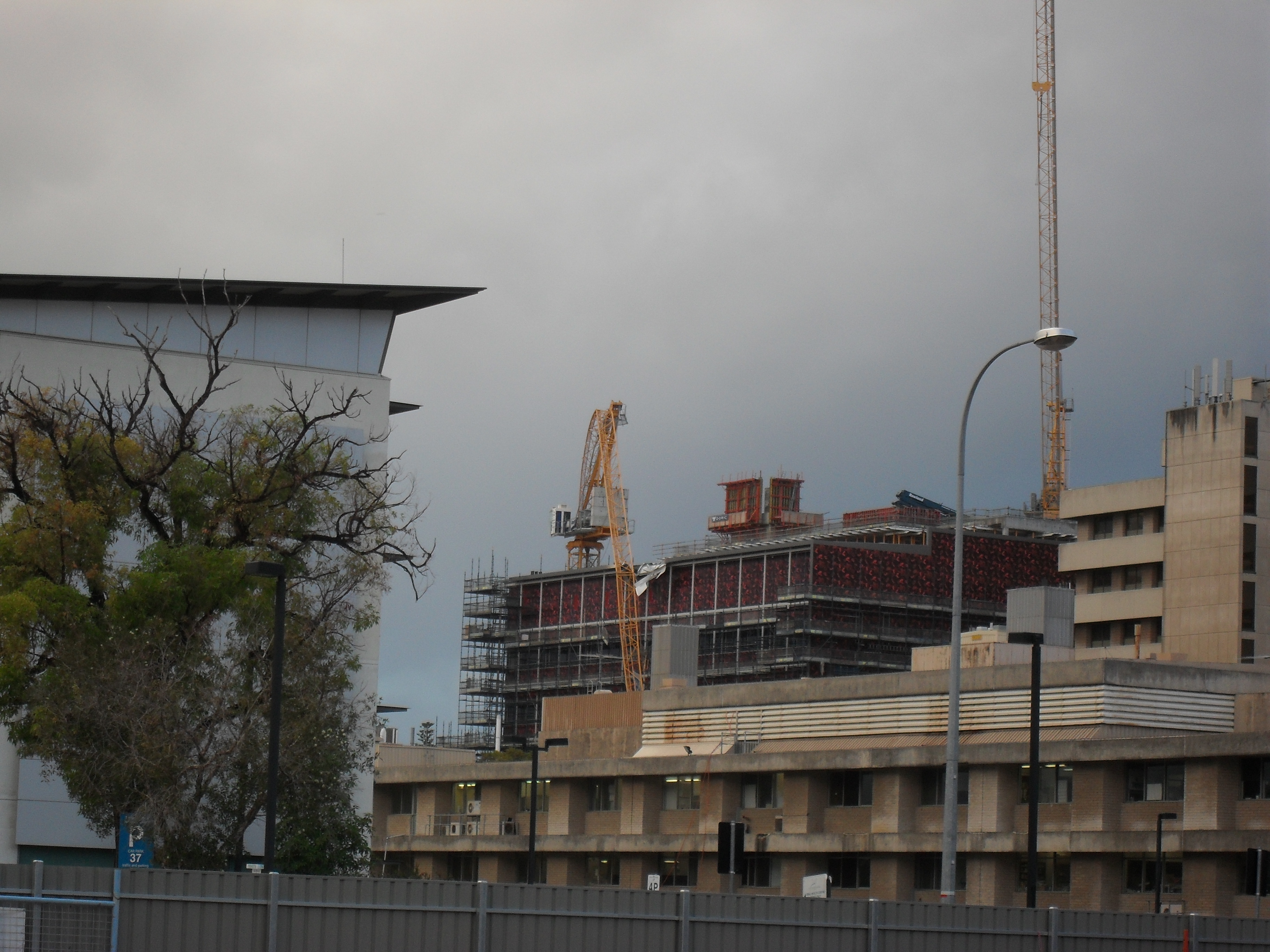
View from my Site Shed looking at collapsed tower crane on enighbouring build
nt and programmeing is required
In other news…has Chris W been let loose on the cranes in Perth (view from my site office looking out on the new cancer centre building). Strong winds in Perth, Western Australia, took the luffing jib of a tower crane over the back and onto the roof of a hospital on Sunday as winds as high as 140kph caused widespread damage to the region. While not yet fully confirmed we believe that the site was closed when the incident occurred and the crane was parked up with the jib at around 75 degrees and the slew brake left on, rather than the crane being allowed to ‘weathervane’.
Further Work
- Dewatering Programme Planning
- Environmental Monitoring
- Work on use of Stormwater System
- Post Tensioning Tender Review (awaiting for State to lift moratorium on all tenders…….long story!!)
- AER 3 – Dewatering, Health and Safety Paperwork and Boundary issues on Site, Relationship between Client, Existing hospital and JHG.
- TMR 2 Research – Project Bespoke Contract v NEC3/ICE 7th
It’s all got a little punchy… 7 May – 20 May 12
Period Covered 7 May – 20 May 12
Summary: It’s all got a little punchy…
I’ve had a great few weeks on site which has mainly been due to my growing role and responsibilities which has opened me up to a number of experiences, meetings and decisions which has widened my understanding about how the project is run, the relationship with the client and commercial awareness.
This has meant I have felt pretty busy with my site work, CI’s Visit and TMR but I am sure no different to anyone else at the moment!! Finally there are now some real issues growing on site and some big decisions that need be made very soon.
During this period I have completed the following:
• Participation in Post Tensioning 90% Design Review
• Contractor Database search and encouraged companies to bid for Northern Superstructure Post Tensioning work. (Cold calling and ppt brief) • Written the Post Tensioning Tender Plan which has been submitted to the client for approval. This included Schedule G – Scope of Works and a review of Schedule H – Standard Sub Contractor requirements.
• Organised and chaired “industry discussions” with Post Tension Subcontractor for Value Engineering work shop. • Senior Engineer for Dewatering Tender Review meeting with Client
• Written Work Risk Assessment for Dewatering Work • Completed Safety Paperwork Preparation for Dewatering Subcontractor arrival on Site (expect 29 May 12)
• CI Visit
• Pre Pour inspections and pour supervision
• Pre Start Briefs
Work on site. So with a lot of hard work, Sunday work and careful micromanagement of the subcontractors the service tunnel is on track to be handed over on time (28 May). The progress has been rapid and I have been impressed with how quickly the blockwork walls and the reinforced concrete roof have been constructed. Syphon A has also now been completed so there should not be a requirement for anymore emergency pumping out!! However, in contrast to this progress has slowed/stopped in many other areas.
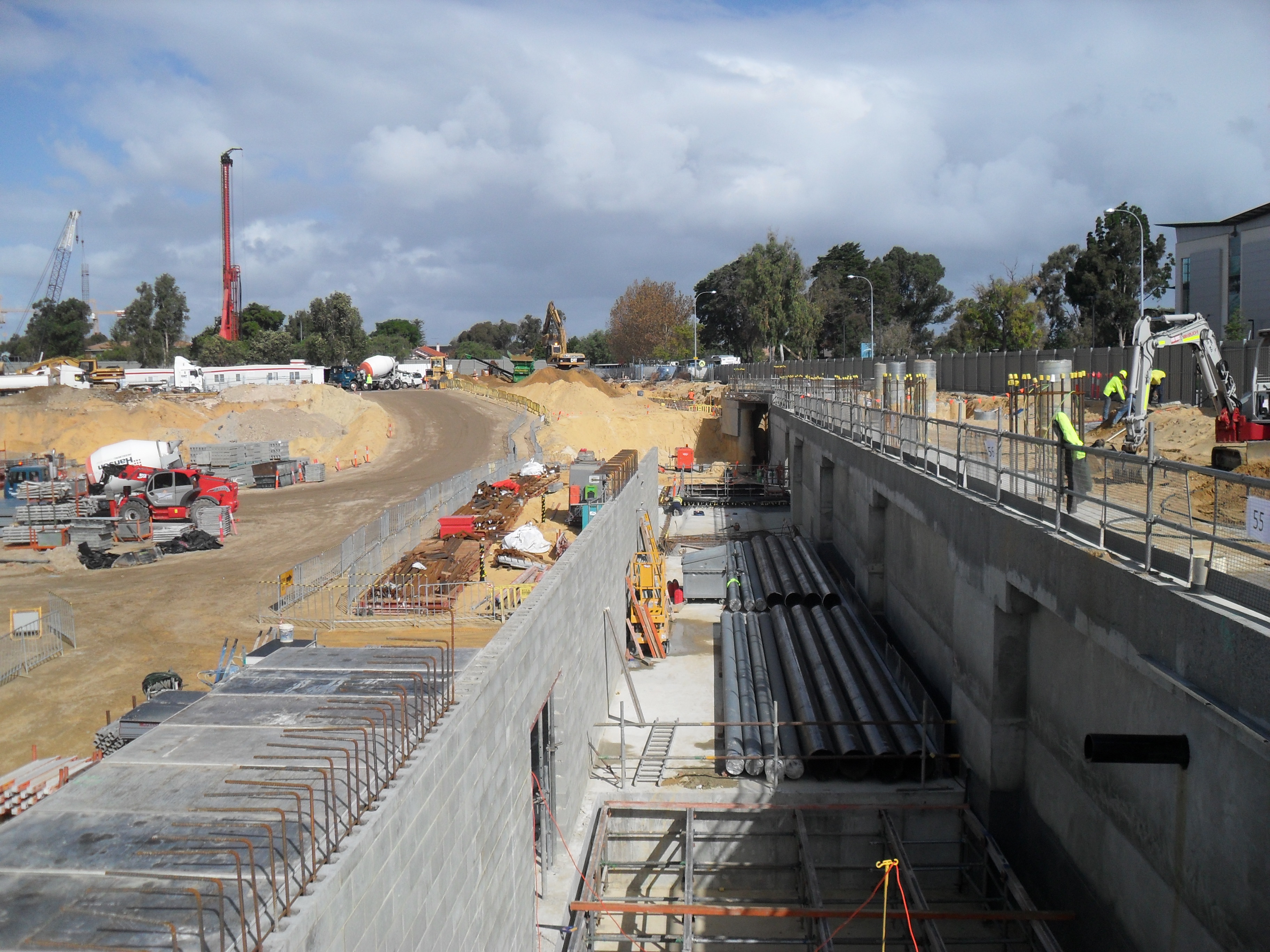
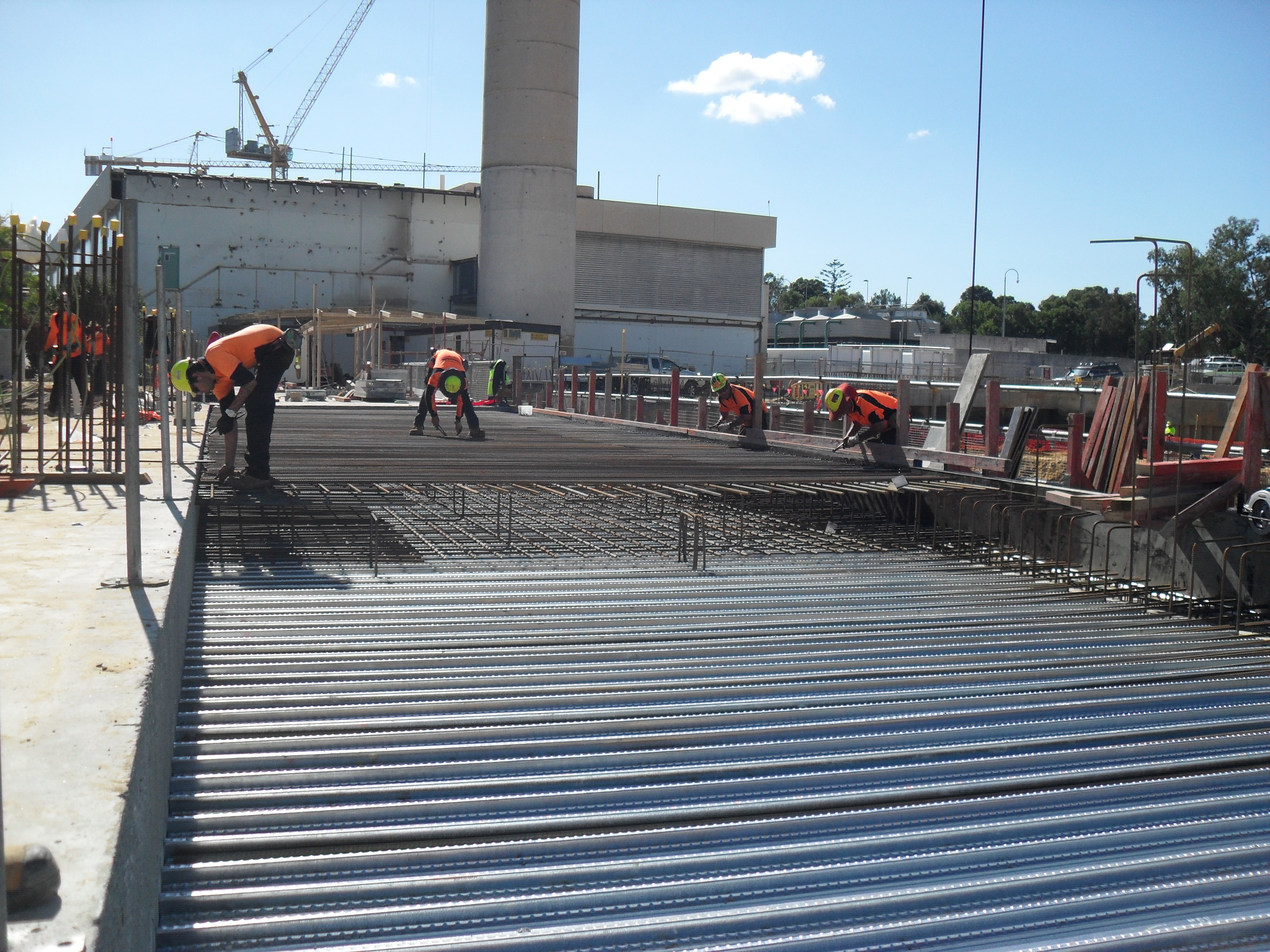
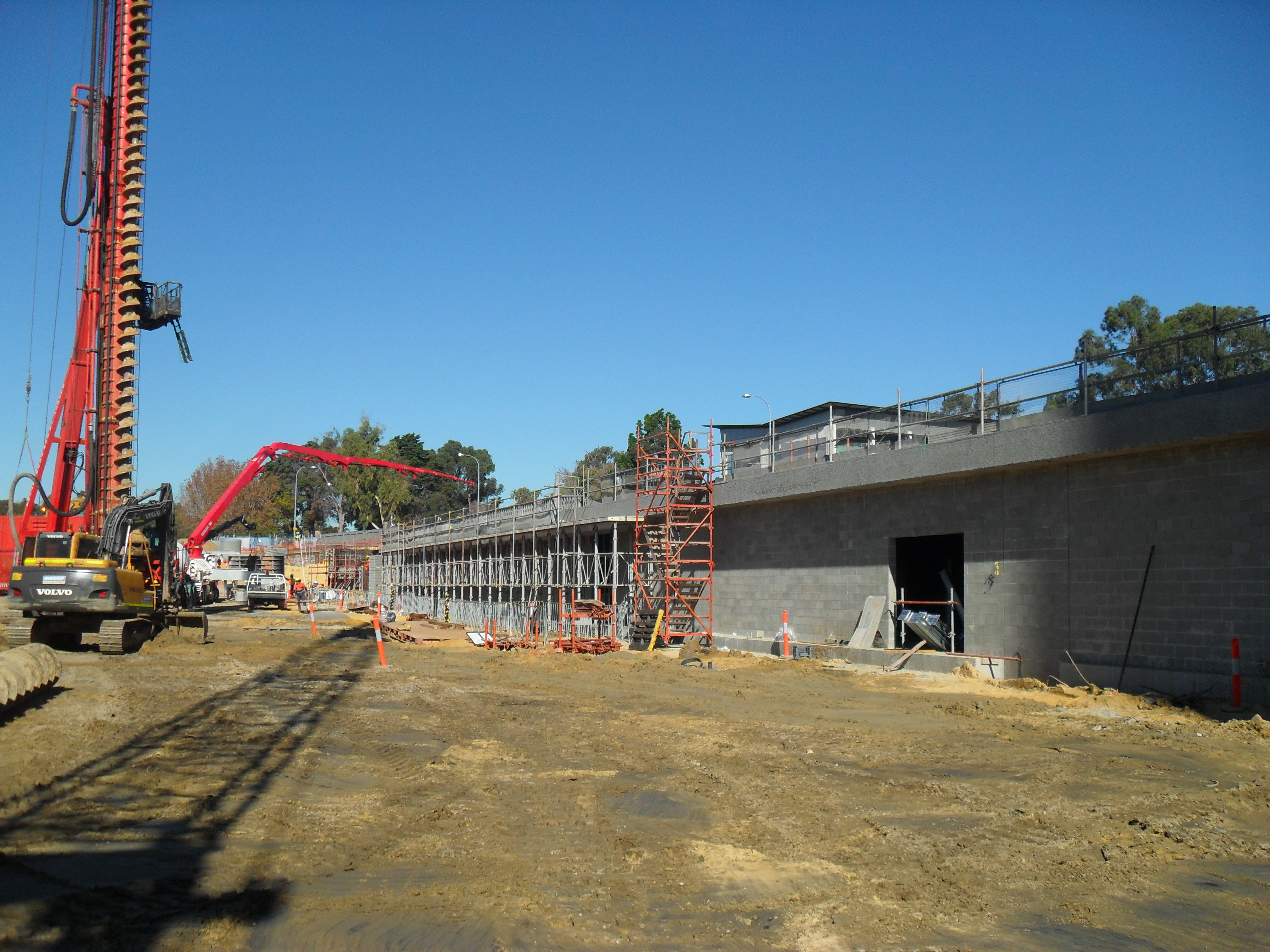
A summary of where this is and the reasons is below:
All excavation in the basement. The capping beams and chimney are monitored for excessive movement and today the surveyors raised the issue that they had recorded excessive movement and the top of the 60m chimney. We are now investigating the cause of this (there is debate about how much the excavation is causing and how much is temperature differential). In the meantime no more excavation is allowed in the basement. I am getting involved with this problem as I think it has the potential to be fascinating issue…however if I can not solve it with freebody diagrams I may need some outside assistance!!
Piling of Zone 7. This area is right next to the service slip lane, with the final 10 piles approx. 2m lower than the slip road. Whilst excavating the sub contractor noticed the road base falling into the excavation and so work was stopped. A combination of shuttering and grout injection aims to fix this, but this has caused a 7 day delay.
Piling of Zone 8. This area is right next to the site fence which backs onto a pedestrian footpath and a bus stop. John Holland understood that when we got ownership of this area (5 April 2012) that we would have access right up to the road. The client argues this was never the case. The up shot is that piling in this area has been delayed whilst John Holland has put together 4 COAs. The client is taking its timing deciding which is its preferred option. This has meant a 10 day delay (and counting) on this area.
Staircore 3. A rapid redesign of the piles for Stair Core 3 occurred last week as the torsional loadings were revised. This resulted in 9 new piles being required, and extra 7 days of work. This has now been completed.
The real result of all these delays is not just the effect on the Piling Contractor but on the Pile Cropping/Trimming teams and the Capping Beams team. Both of these sub contractors had just inducted serious numbers of people in preparation for the increased work load. However with these delays there has been a lack of work and these labourers have found employment elsewhere and are unlikely to return to the project. This is real problem, as Subcontractors are unhappy and there could be a lack of inducted personnel available when there is work! Fingers Crossed these issues are resolved quickly so work can continue at the pace we are used to.
MORE PHOTOS:
Areas of Site where work has been delayed
My Experience.
So my work as a supervisor has officially ended, this was an excellent way of introducing me to the project, sub contractors and the John Holland Systems whilst in a position to pick up decent engineering work when it arose. I am now fulfilling my Engineer role and since then I have not stopped. Being the lead for the post tensioning work has been excellent, as I will see the $3 million worth of work go from my initial thoughts on what should go in the scope of works right through to delivery on site.
This has given me exposure to the contract administrator team who I am working with approximately 1 day a week and hands on experience of the tender process. I am sure I will have a lot more to write about once comments come back from the client (the state) on my tender plan, but so far so good!!
As part of the post tensioning work I attended a 90% design review with the structural designers and the client to discuss the Post Tensioning work for the Northern Superstructure. The technical side to this was interesting but not as interesting as the commercial aspect. In what I think is a very weird decision John Holland is being allowed to bid as the “builder” for the Northern Superstructure works package and thus to ensure probity there are some very funny restrictions in place about who can talk to who about what…the result being to ensure John Holland doesn’t have an unfair advantage compared to the other sub contractors who are bidding to build the work. Hmmmm, if you were a company would you bother to bid if you know the company managing the build is putting in a tender….anyway I played the values and standards of a British Army Officer down to a tee which was well received by the retired Australian Defence Force Officer, now probity officer!!
The other project taking up my time is being the lead engineer for the dewatering work on site. In the last week this has involved a couple of pretty hostile meetings with the client, where they seemed to forget all the meetings and dialogue we had up until that point and I had explain why, where, what and how once again. The upshot of these meeting was that I was ordered to do another option study of an option which was discounted a month ago – this option (using an inaccessible sewer) being the least environmentally friendly and most expensive option again..48hours later, we have agreed my original plan is the one they should sign up to!!!!! We still need to get the contract across the line but it looks like we are there now and my focus is ensuring the site is ready for their arrival.
(As an aside, I have been spending a lot of my time liaising with local councils, water companies and other drainage providers to arrange permission and licences for the dewatering, Dan K tells me that this is covered on the E&M course, it might be worth bolting this lesson onto the Civil dewatering lessons?)
Further Work
• Tender Plan Review meeting with the Client to discuss Post Tensioning
• Meeting with dewatering subcontractor to ensure all preparations are ready for start on site
• Safe, Quality and Enviro Safe Systems of work co-ordinator for Dewatering
• Involvement in new pedestrian footpath
Engineer..?
Period Covered 23 April – 4 May 12
Summary: Engineer…?
My responsibilities have grown considerably over the last 2 weeks as my role has shifted away from supervising to being a project engineer. This has happened rapidly and I have to balance my on site work with office based work. Efficient time management and communication has been essential as I have also been away from site for 4 days (AER writing, ANZAC Day and 2 days on a Safety Course.)
Also during this period the weather has shifted and the rains have begun. This has caused considerable disruption and as foreseen in my last blog it will be the simple/stupid errors that threaten the job and not the complicated technical aspects.
During this period I have completed the following:
- Supervision of GMF ground work contractors – bulk & detailed excavation and pile cropping
- Technical Anaylsis and plan for project dewatering, including brief to client. (Support from John M really appreciated)
- Dewatering Tender Analysis and award of $700,000 of dewatering work. (13 deep excavations and 180 pile caps)
- Dewatering Activity Method Statement written
- Given responsibility for approx. $3 million of Post Tensioning work. I will be responsible from writing the scope and schedule of work through the whole of the tender process to implementation on site.
- Completed TRA and Hazard Inspection audit
- Attended 2 day Safety Risk Leadership Course
- Safety Supervision
- Programme co-ordination meetings
Work on site. Exciting times on site as the Northern end of the service tunnel has begun to look like a tunnel with the blockwork wall being constructed and the formwork for the roof slab in place ready for a pour this week. Work on the remaining sections of the tunnel continues but the arrival of the rain has caused disruption (lost time, unable to waterproof in the wet and the problems with Syphon A, see below).
The remainder of the site continues its steady progression with the site opening up as the bulk excavations continue and piling the final portions of the retaining system has begun.
Finally, worthy of note is that work to divert a high pressure gas main in the North East Corner of site is due to occur on Monday. Once complete this will enable the completion of the logistics sliplane and provide a drive in/drive out solution to material deliveries. This work has been delayed for 3 months whilst the Client and Power company come to an agreement!!
Issues/observations. Water Water Everywhere:
With torrential rain arriving in Perth it has caused considerable problems for the Southern End of the Service tunnel.
The first bout of rain arrived overnight last Saturday and resulted in the collapse of an excavation. This was dramatic enough but was made worse as it covered the final portion of the service tunnel that had not had its slab poured. The collapse caused a 10m x 10m area containing the already the set out reinforcement ready for a pour on the Monday to be covered in sand. This took 3 days to clear as the reinforcement was stripped back and various “honeysuckers” were employed to clear the sand away from the mesh.
This meant by Thursday parity was reached. Just in time for another morning of torrential rain on Friday. What was first suspected as just bad luck (no one was on site to see the first collapse), turned out to actually be a simple mistake by the project.
In order to connect the hospital to the storm water system (run South to North) a serious of symphonic drains (connected chambers) are required to store water and divert it under the major energy services will run ( they run East to West). The syphons had not been fully constructed (not an issue in the dry) and the project had forgotten/not thought about capping the inflow from the rest of the surrounding area’s stormwater system.
As a result a “water flume” began pouring out of the unconnected syphon and flooding Area A again!!! After much wading around and “playing” with small grindex type pumps we lost the battle! A more permanent solution has been devised we plan to construct a sump where the stormwater enter site and a gilkes pump to pump water from the sump past the offending unbuilt symphonic drainage system and into the existing stormwater system.
Storyboard to Show Area A Problem
Further Work
- Continue with dewatering plan. Liaison with contractor, co-ordination with contract administrators and sub contractor to ensure delivery on site.
- Post tensioning work. Write tender plan and schedules in order to brief management on Wednesday and begin the tender bid process.
- Prepare for CI’s Visit.
APMP…
Kenny found my results in the Mess pigeion hole, seems I got a high of 100% for question nine, low of 48% for question four and an average of 63%. Seems that leaving the KGV at midnight (following Geek Club) paid off. How did everyone else do?
Week 4: Edges and Arguements
Period Covered 10 – 12 April 12
Summary: Edges and Arguments
At last I have been on site for a continuous period of time and as a result feel like I am now bedding in and understanding the daily rhythm on site and getting to grips with the detail. Though my role has not altered, my responsibilities have grown – as a result of knowing a little bit more but mainly covering people who are away on Easter Leave.
During this period I have completed the following:
- Supervision of GMF ground work contractors – bulk & detailed excavation and pile cropping
- Application of SQE RM Course – Completed Task Risk Assessments for elevated work
- Review of drawings – answering Sub Contractor queries
- Concrete Pour Quantities and ordering deliveries for site
- Safety Supervision
- Programme co-ordination meetings
Work on site. Work is frantic at the moment with a big push to complete the service tunnel which as I mentioned before is the first milestone for the project and will be how the State judges John Holland. The good news is that there seems to be a real sense from the sub contractors that they will do what it takes to get it done for the handover (first section of tunnel to be handed on 28 Apr) however I have a feeling real life (Murphy’s Law) and a fundamental procurement problem with the waterproofing solution (more to follow) will mean we may miss the deadline.
Issues/observations. I have picked out three things that have interested me in the last couple of days:
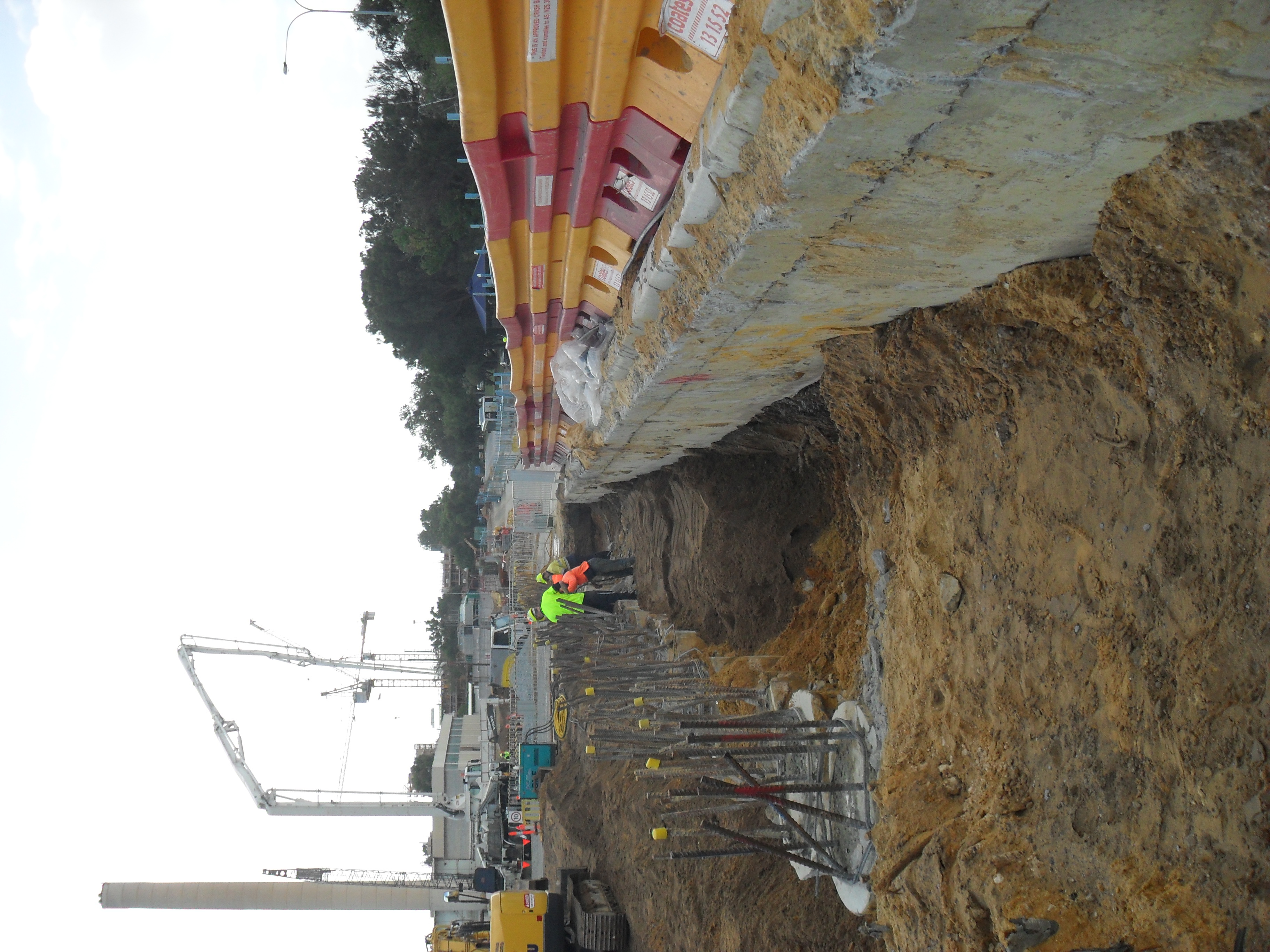
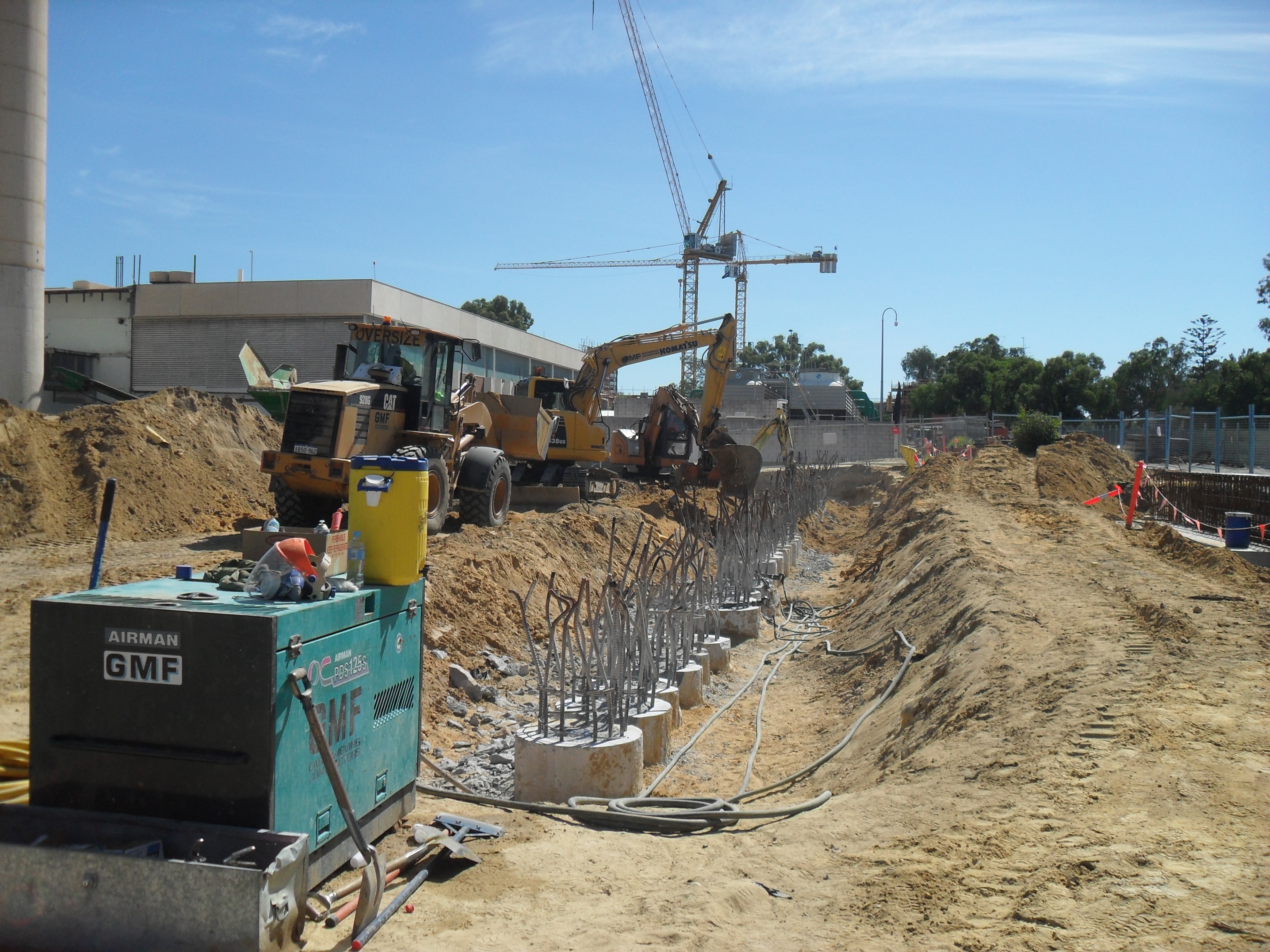
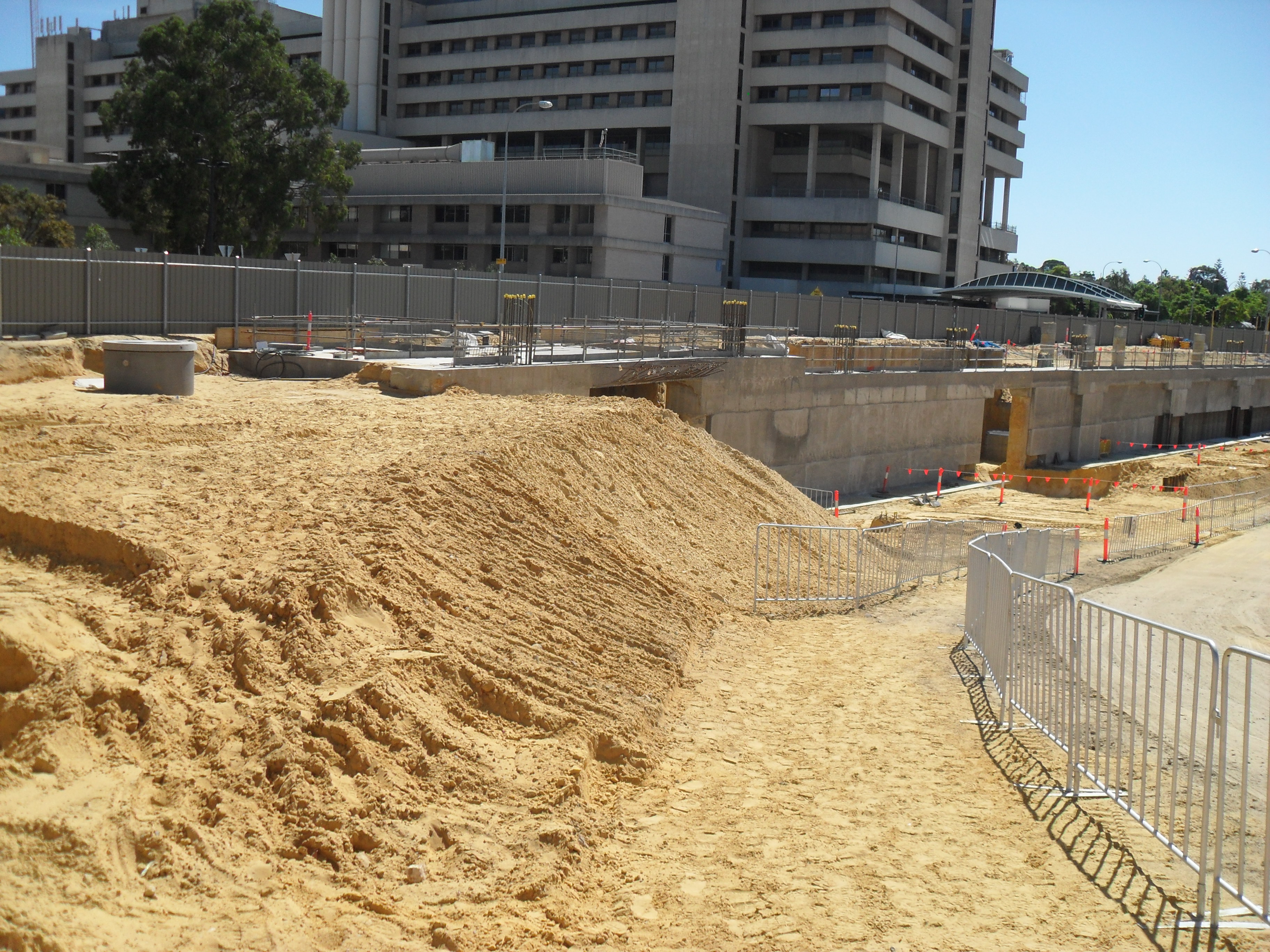
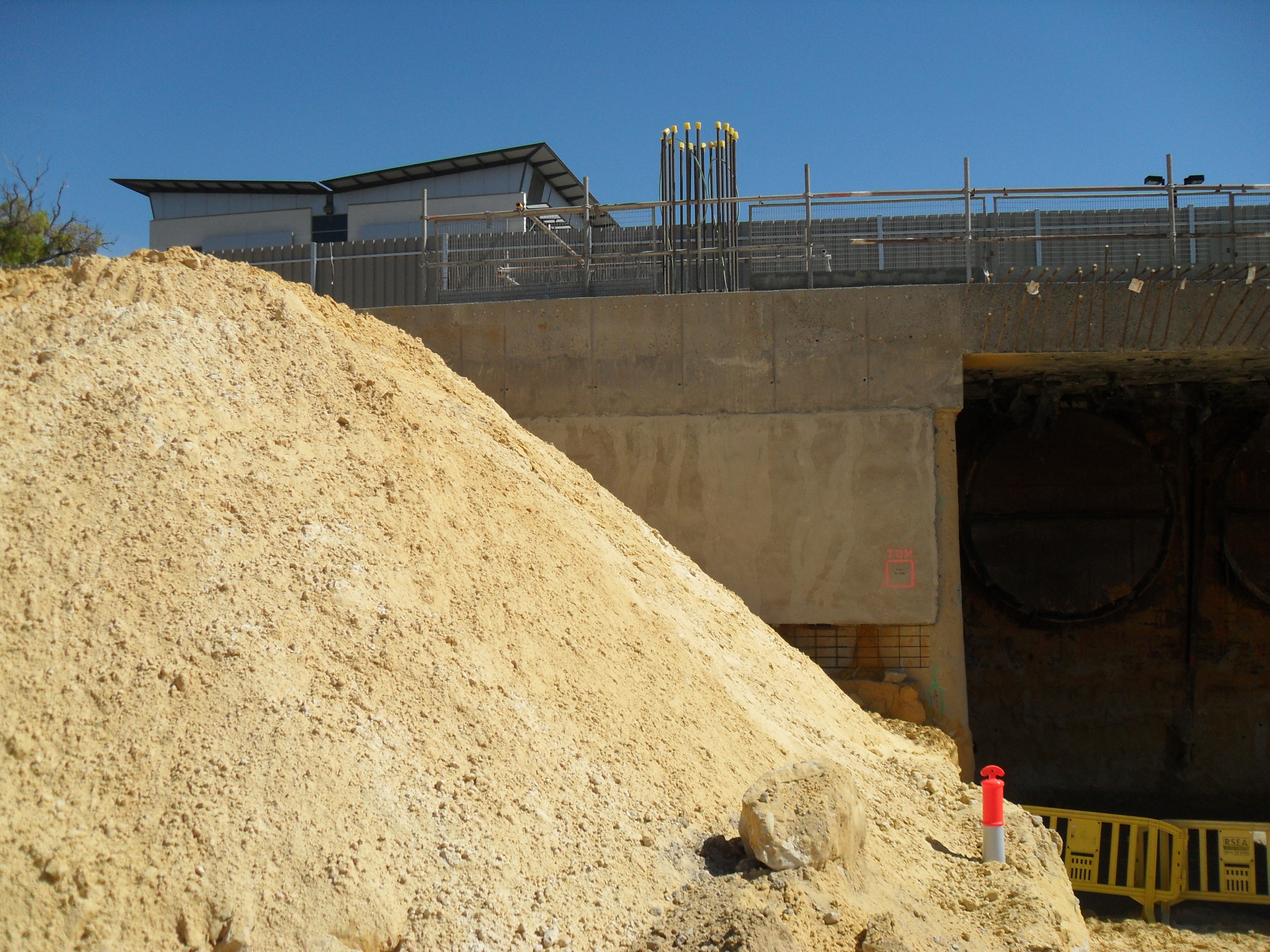
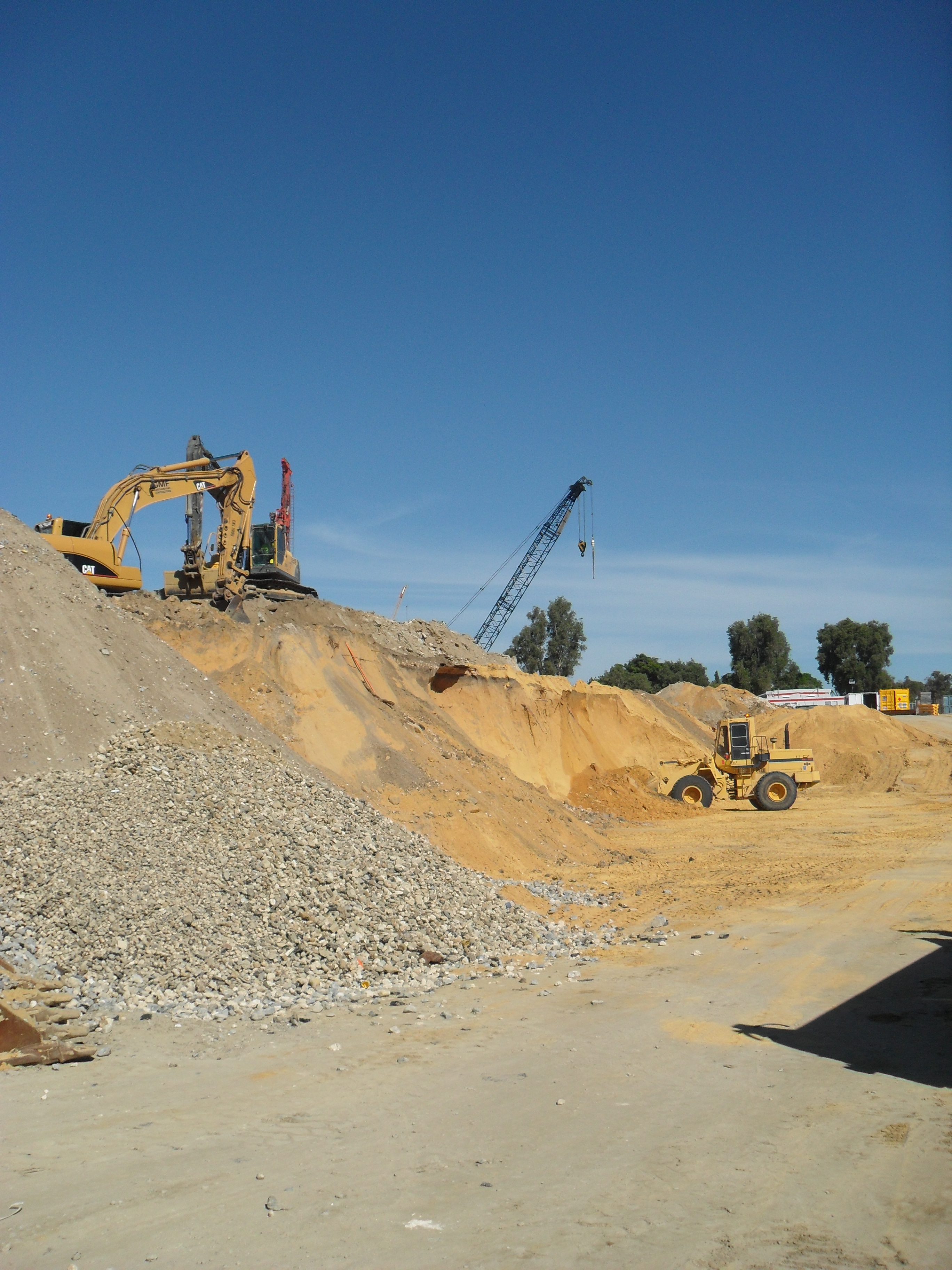
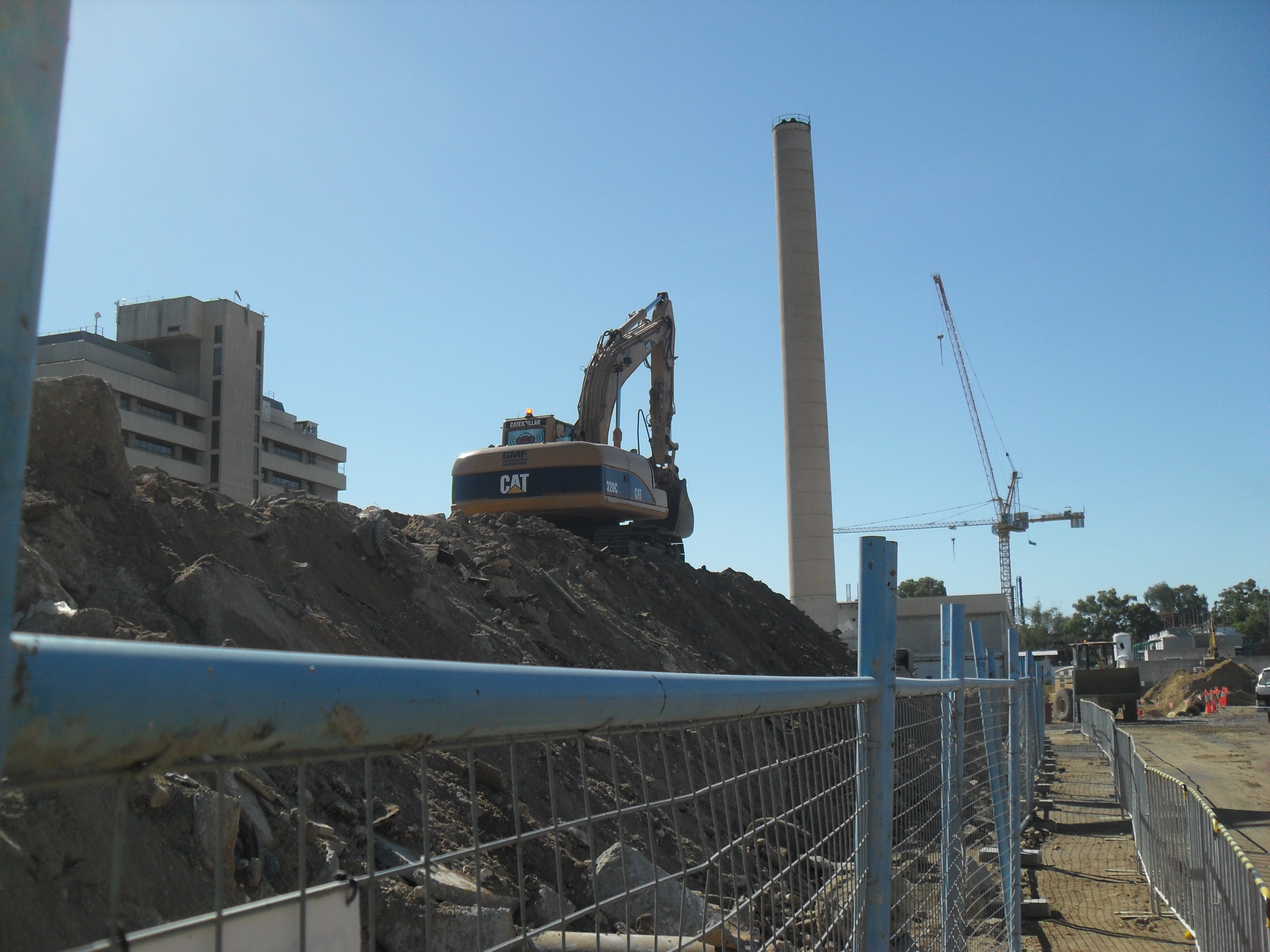
a. When is a fall from height a fall from height. The rules at working at height have recently change in WA and from an arbitrary 2m, the rule now states that it is when the risk is felt to be too great. I have been giving this some thought and it is a very subjective view on what constitutes working at height and more pertinent to the groundworks when is an edge an edge and require a barricade: And then when a barricade is required is it a soft barricade (bunting/Mesh) or a hard barricade (Water barrier, Earth Bund). The photos below hopefully illustrate this a bit better…but all of this means on site plenty of discussion from subcontracors before they do what we tell them.
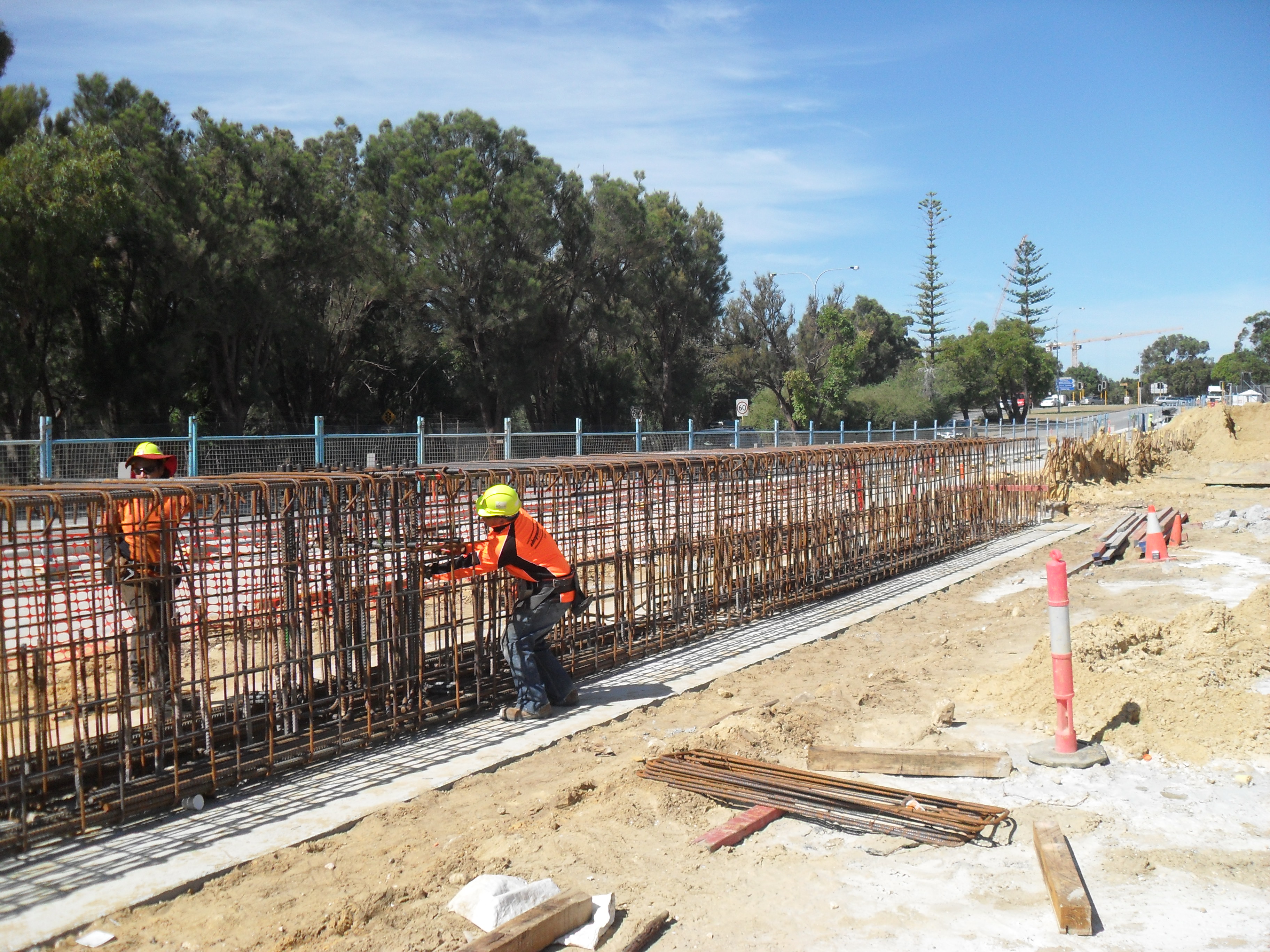
b. Safety v Relations with Subcontractors. Having just come out of a safety meeting which had specifically directed that steel fixers walking on 1.2m high reinforcement cages was not to be tolerated, I felt on pretty safe ground when on my safety walk around I saw two fixers doing exactly this. What I was not prepared for when I told the supervisor this was not to happen was a heat exchange about what did I Fxxxking know and to shut the f**k up. Moral courage tested but not broken I stood my ground and expected him to see the error of his ways, what really happened was that he collected his team and tools and walked off site!!! This left me thinking momentarily if I really had done the right thing.
Thankfully a radio call to the site manager headed them off and after another heated debate a safe solution was found – so though the end result ended in the work being done safely. I have reflected that I still need to work on how I talk to Sub Contractors.
As an after thought a lesson for when I design – it was obvious whoever had designed these capping beams had not considered a safe method of work for the steel fixers to construct the reinforcement cage.
c Programme Changes. A weekly team and subcontractor programme meeting occurs, however the programme changes on an hourly basis. This is being mainly driven by the site manager who is keen to capitalise on any opportunity to “speed” up the programme. In some cases the benefits are massive but I am concerned that by constant, spur of the moment programmes changes this unsettles the sub contractors and at worse is not communicated to all on site, leading to an eventual delay!
My Experience. It is been a busy few days since Easter but it’s been great to get some consecutive days on site. Responsibilities and experience are growing steadily but I still have loads to learn to ensure this progress.
The site has recently been delivered site radios so I having been teaching everyone voice procedure… we’re not quite up to SOC 4, obstacle crossing yet but we’ll get there….so now even my armoured engineering experience has been useful!!
Further Work
- BIM Meeting tomorrow with AEC systems as part of TMR research
- Thesis Topic – I am starting to research into a pile thesis, I have discovered that the service tunnel and the hospital have been designed as separate structures and have different load profiles, as they will be connected I have been informed that the piles have been designed separately to ensure settlement occurs equally and differential settlement is avoided. The settlements will be monitored so this can be compared to the design values (A phone call to JM to follow very soon)
- Consolidate work on site
Week 3 & 4: Training
Period Covered 23 Mar – 4 Apr 12
Summary: Training
A brilliantly frustrating 2 weeks which has been characterised by a whole host of training courses. On one hand this has been great as the courses have been really useful and have possibly inspired my second TMR topic but at the same time frustrating as they have come at a time when I was just establishing myself on site and I have just sat in a classroom for 9 Months (fear not PEW lecturers I did not give the Aus lecturers an easy time either).
During this period I have completed the following:
- Supervision of GMF ground work contractors – bulk and detailed excavation, pile cropping
- Set out and supervision of service pits in service tunnel
- Qaulity Assurance pentrometer testing
- Risk Assessment and Hazard Inspection Audit
- Programme co-ordination meetings
- Operational Safety Quality and Environmental Risk Management Course
- Louts Notes and Project Pack IT Training
- Working Safely at Heights course
- Reports and returns – Site Diary etc
As a result of all my training courses I do not have much to write about this week. As a result please see a shamelessly large number of photos.
Work on site. I have been impressed at the pace of work on site. The amount that has been achieved has been incredible. 120 x 20T trucks a day of spoil has been removed on site and the ground excavation is really progressing. This is beginning to open up the site and for a short time will alleviate the space shortage. The service tunnel to the West of the site is still the priority as this is the ONLY milestone in the programme less practical completion!!
Issues. A couple of issues to think about:
- How are tenders one? I have not yet had experience of the complete tendering process but I am beginning to understand how business is done; though a lot has been made about employing quality rather than the lowest bid, this has not been borne out by the earth works contractor, who I know was the cheapest tender by a considerable margin and in my opinion have bid to low for the job and are currently under a lot of pressure to minimise overheads. This creates a lot of day to day friction and from a managing contractor view means we can not capitalise on opportunities as GMF to do not have the resources to be flexible. On the other hand the concrete contractor, Crown, are falling over themselves to be proactive and helpful (and in my eyes professional) as they want to win the contract for the superstructure construction and as a result are desperate to impress. The earthworks contractor has no such incentive.
- Stopping in the Rain? Unbelievably we have had a few showers in Perth over the last week. I have been bemused by the immediate reaction to stop work as soon as it rain. It is a shame this safety culture does not extend to every practice on site!
My Experience. I am still having a really positive time on site but I have been frustrated by the number of times I have to tell someone to do something. This apparently is a normal frustration for attached officers according to my Works Package Manager who has worked with a few sappers before….why can’t civies do what they are told!!
Finally I undermined all my good first impressions by getting my UTE bogged down in a particularly soft patch of sand on site….
Further Work
- Continue on site as supervisor, deputise for site manager in his absence
- Hold Safety workshop with Safety Advisor to encourage UK best practice and culture (try to attend Strategic Safety Course which is focussed at culture change – possible TMR 2 Topic)
- Begin research on BIM for TMR 1
- I am currently all out of Thesis topics. I have been canvassing on site but the general impression is that building a concrete box on sand is not really that cutting edge, so I would be grateful for any help from anyone in the UK to focus my thesis thoughts!!
- Conitnue to train for Corporate 14km race in May…Charity appeal to follow
Supervision, a spoon drain and SCAB!!
Period Covered 20 -23 Mar 12
Summary: Supervision, a spoon drain and SCAB!!
Work as a supervisor has begun in earnest with safety (monitoring on site, paperwork audits etc) and sub contractor co-ordination my top priority. I am understanding how the site operates, meeting the sub contractor supervisors and building a working relationship with them
During this period I have completed the following:
- Supervision of GMF ground work contractors – bulk excavation and pile cropping
- Risk Assessment and Hazard Inspection Audit
- Co-ordination/supervision of Union Rep
- Service tunnel spoon drain – liaison with design team and contractor (contract dispute)
- Reports and returns – Site Diary etc
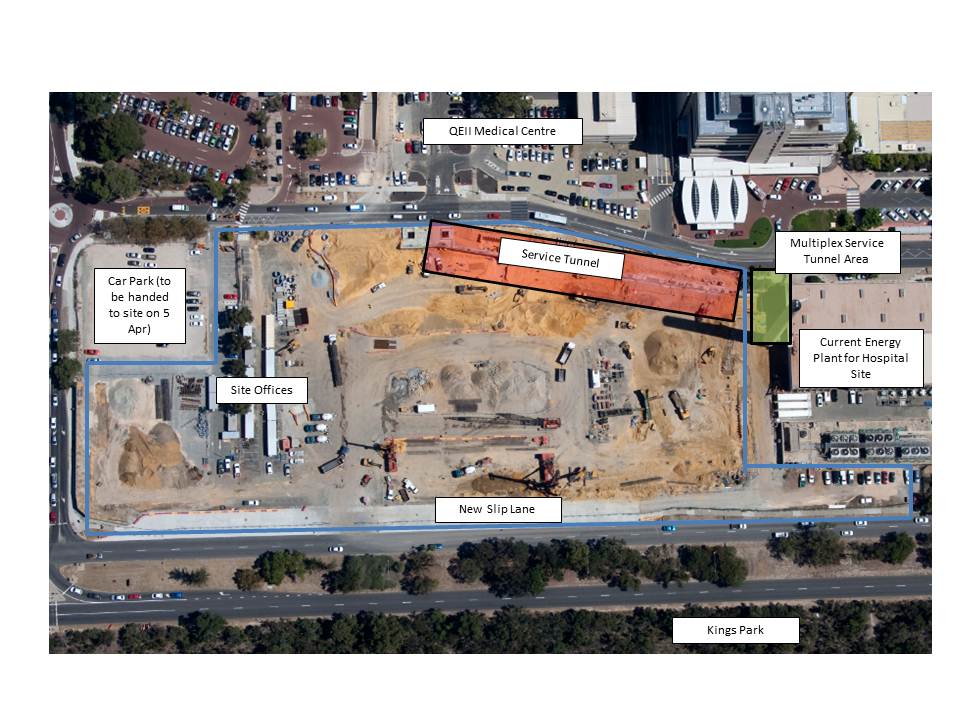
Aerial Photo
Work on site. No Change – less GMF (cropping pile team) and Crown (concrete capping beam team) contractors have been stood down until Wednesday as a result of safety concerns in order to allow adequate working space between piling and other contractors.
Issues. Considering the site has been going for only 10 weeks there seems to be a growing number of problems. The highlights are:
1. Congestion of Site/Possession of Northern Boundary by Multiplex. The first milestone on the project is to handover a new service tunnel to link the services to a new constructed energy building. This is driving the programme and the focus is to deliver the first stage of the tunnel to the client on 2nd May and the whole thing on 29th May.
However as a result of the client handing the most northerly section of the tunnel to another contractor work in this area by JHG sub contractors has been severely restricted. In an attempt to catch up time the piling, pile cropping and capping beam contractor were all compressed in the same area. This led to lots of co-ordination/in fighting with the sub contractors (good work for an army officer acting as a supervisor). This went on for 2 days until a call was made that it would be safer and more efficient to pull everyone less the pilers away from that area.
2. Spoon Drain. The service tunnel has a spoon drain at the bottom of it to collect and drain water running along the inside of the retaining piles. This was a detail which though pretty simple I spent a lot of my time this week dealing with. Until I got involved there were no dimensions or levels for this, and it took a lot of going between the Architect and the Structural engineer to determine who was responsible for this detail and to get the required dimensions.
Along with this the earthworks contractor initially refused to do the detailed excavation required for this work and it took the involvement of the Works Package Manager, the contracts administrator and myself to get to the bottom of it. It transpired that detailed excavation was not included in the Lump Sum part of the contract but was included 5 sections later under a schedule of rates section….problem solved after a bit of tension.
3. Trade union relations. Australia has a very different set up with powerful trade unions which are normally part of/affiliated with construction companies. John Holland has a different view and believes it can have a better relationship with its workers directly. This seems to work fine, less the relationship with John Holland and the Union Reps. Recently on site the Reps are coming on site to cause trouble and on one occasion the police have been called. As a supervisor I was responsible for babysitting the Rep during his last visit to site and ensuring he followed the rules. Interesting but a little weird!!
4. Oh Shit we hit something. Initially on site there were many services crisscrossing site and these have mostly been removed with a plan to remove the final few in the next 10 days. On Friday however whilst excavating the service tunnel a 150mm water pipe was struck and water released onto site. Emergency plumbing works will finish the diversion of this sewer over the weekend and the site was lucky as the water was “clean” (cooling tower condensation water) and will easily disperse in the Sand. Of more of a concern is that there is a High Pressure Gas main in the north of the site which we are still waiting permission from state to relocate….lets hope we don’t hit this!!
My Experience. I’ve been amazed at the speed of progress on site. The excavation progresses at 100 trucks a day as well as 10 CFA piles per day. My role has developed with me deputising as site manager on my third day, as the real site manager was on a training course and I have worked more with the engineers, trying to sort out the spoon drain detail – this has also given me some commercial experience and my initial naive thoughts of working as a team have been banished as commercial arguments have occurred this week.
I have observed the difficult role a managing contractor has. There is a balance bewtween a working relationship with the subcontractors and acting in clients and John Holland’s interests. This becomes evident with Safety v productivity issues. My view is that John Holland as an excellent paperwork system which should ensure safety on site and this understood by the Engineers and the Management but there is still a core of Supervisors who see safety as getting in the way – this will mean a constant battle to keep on top of this.
Finally, I have realised the importance of sketching. This is how I have been communicating with all of the subcontractors this week. Whether it be simple site plans or more complicated design detail being able to sketch quickly and clearly is obviously an art which I need more practice at!!
 Holdfast Training Services Trial Blog